Dear readers,
L’Oréal is one of those companies that everybody knows and very few investors really study. After two years of China worries, the stock is back close to its 2024 high, because growth re-accelerated in 2026: the best first half in years and a strong Q3. This time we go deeper than usual: L’Oréal is really four businesses (mass, luxury, dermatology and salons), each with its own competitors, so we study each one before looking at the numbers. Let’s go step by step.
Disclaimer. Please read full disclaimer at the end of the page before reading the article. This publication is only for information and entertainment purposes. It doesn’t constitute financial advice.
Please remember that nothing in this post is investment recommendation.
I. Executive summary
Most of you probably know Garnier shampoo, have seen Maybelline ads or a Kérastase mask at the hairdresser. Or perhaps bought a bottle of YSL Libre as a present? Then you have been a L’Oréal customer, probably without knowing it.
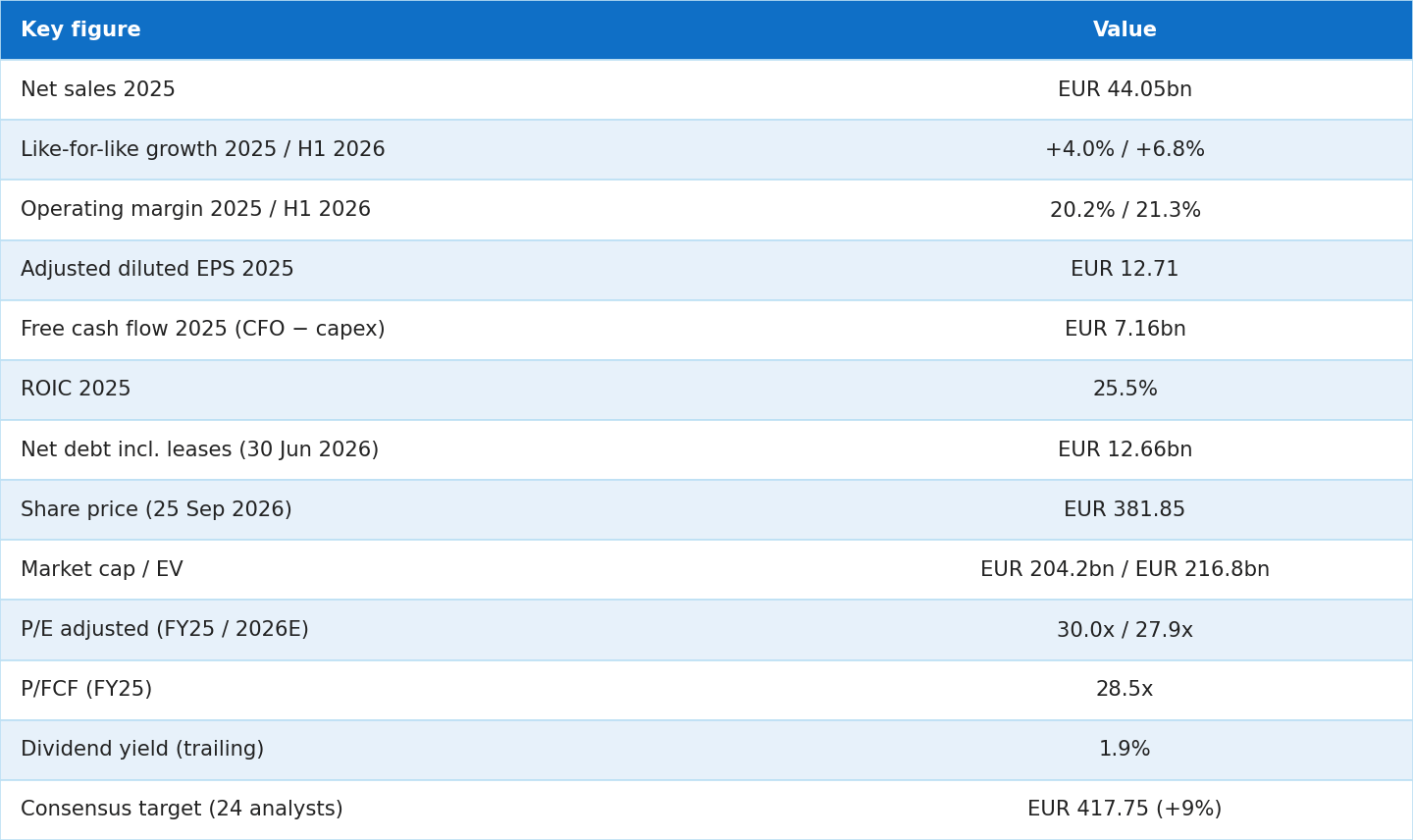
L’Oréal is the largest beauty company in the world. It sold €44.05bn in 2025, it is c.1.8x the size of the number two, and it has grown faster than its market in almost every year of the last decade.
The first thing to understand is that L’Oréal is not one business. It is four businesses under one roof, each with its own channel, its own competitors and its own economics:
Consumer Products (€16.1bn, 36.5% of sales): mass beauty in supermarkets, drugstores and online. The biggest and slowest-growing Division, and the cash engine.
L’Oréal Luxe (€15.6bn, 35.4%): prestige beauty, now above all a fragrance house. #1 in luxury beauty worldwide since 2023.
Dermatological Beauty (€7.2bn, 16.4%): skincare recommended by doctors. The star of the decade: sales x3.9 since 2016 and the highest margin (26.1%).
Professional Products (€5.2bn, 11.7%): hair salons. A quiet compounder with a 27% share, more than its next three competitors combined.
I see four main pillars of value:
First, beauty is a very good market. It has grown every year of the last decade except 2020, at c.4–6% a year in normal times, and McKinsey expects c.5% a year until 2030. People keep buying shampoo, cream and perfume in good and bad times, and I believe the trend will likely continue.
Second, L’Oréal is #1 in three of its four markets and the largest pure player in the fourth (mass beauty, where P&G is of similar size): #1 in luxury beauty in all four regions, #1 in dermocosmetics with 25.8% share (c.4x the next player, our estimate) and #1 in professional hair with 27%. And it spends c.€14bn a year on advertising, which nobody else can match. Let me repeat it: €14bn a year on advertising.
Third, the numbers speak by themselves. Since 2016, sales grew +6.5% a year, the operating margin went from 18.1% to 20.2% (21.3% in H1 2026), adjusted EPS doubled from €6.46 to €12.71 and free cash flow went from €3.4bn to €7.2bn. Every Division improved its margin over the period.
Fourth, growth is re-accelerating, and in the right places. After two weak years (2024 +5.1%, 2025 +4.0% like-for-like), H1 2026 came in at +6.8%. Professional Products (+11.6% adjusted) and Dermatological Beauty (+10.6%) are back to double digits, and Luxe (+5.1%) is recovering with China.
So, the inevitable question is: why did the stock spend more than two years below its June 2024 high of c.€460? Because investors were worried about China, travel retail, the US consumer and the end of the post-Covid beauty boom, which hit exactly the two Divisions that had carried the group (Luxe and Derma). And because the starting multiple was very high.
After Q3, the stock is back at €450, only 2.5% below that high. At this price, L’Oréal trades at 35x FY2025 adjusted EPS, 33x 2026E and 34x free cash flow. Is it cheap? No. Almost all of the 18% rally since September is a higher multiple, not higher earnings estimates.