

Introduction
Antin reported earnings on September 9th, and again, the company disappointed. The new fundraising cycle keeps delaying, and the company is loosing credibility as it’s not meeting the expectations. It’s disappointing as current expectations might not be met.
The main reason was the delay of the activation of Mid Cap II, a fund currently in fundraising, that has been delayed until end of the year. Management cited that the main reason behind this delay is that they want to have one investment ready to maximize efficiency for LPs.
Fundraising cycle keeps delaying as the company is not transacting as it expected.
Disclaimer. Please read full disclaimer at the end of the page before reading the article. This publication is only for information and entertainment purposes. It doesn’t constitute financial advice.
The information provided in this blog is for informational purposes only and should not be considered as financial, investment, or professional advice. The valuations and analyses presented here are based on publicly available
Please remember that nothing in this post is investment recommendation.
1. Mid Cap Fund II has been delayed until end of the year
While this is not the end of the world, it’s disappointing because Antin needs to start delivering in the fundraising front.
Mid Cap II’s activation slipped from Q2 to Q4 2026 because Antin ties fund activation to the fund’s first investment, and that first deal hasn’t happened yet.
This has one consequence: management fees will not be perceived until the fund is activated. However, for long-term investors, a delay of two quarters of a small fraction of management fees is not a big issue.
My reading:
Antin is not delivering on investments and divestments — Current environment has created distortions that are delaying the investment and divestment activity.
Investors are willing to invest in Antin’s funds, but are requiring a more efficient approach as investments are taking longer than expected for the Fund VI, and distributions are also delaying (Mid Cap I has not returned any capital yet to investors).
If management expects activation by Q4 2026, means that they currently have something in the pipeline at and advanced stage. Once the fund is activated we will know the target size and the current appetite for Antin’s funds.
The delay itself is not the issue, but rather the underlying messages.
2. Flagship VI will likely be delayed, unless company deploys capital fast
Antin still needs to deliver on two fronts to ensure they can raise the Flagship Fund VI:
Return capital to LPs from Fund III
Finalize the investments of Fund V (between 2 and 3 remaining).
Returning capital to investors will likely take several quarters, and recent performance is being quite weak
Antin reported the following slide, in which we can see that there are no ongoing processes for Fund III. The company will need to extend the life of the fund, which is a 2016 vintage. Extending the life of a fund is not a positive sign.
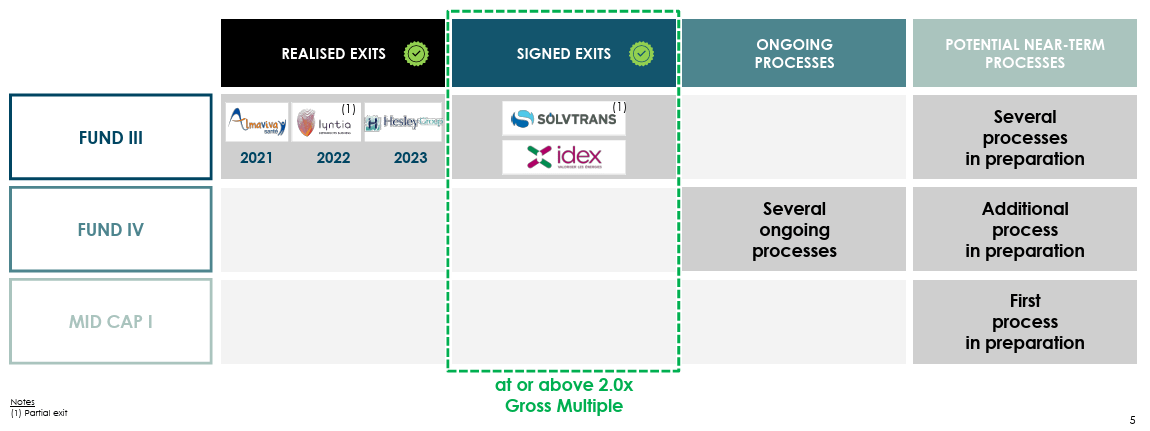
The longer the period, the more difficult to achieve he targeted IRRs. Fore reference, Antin reported gross multiples of 2.0x and 2.4x, for Idex and Solvtrans, respectively. However, these investments were made in 2018 leading to very modest IRRs between 9-12%.
The fund still holds CityFibre, FirstLight Fiber, Elanta and Kisimul. There are not ongoing processes according to the management, and press reports point to FirstLight Fiber as the potential next candidate.
Since the IPO in 2021, the company has made 7 exits, which represents around 1.4 exits per year. If teams keep that pace, it is unlikely we see a full divestment in 2027.
This adds even more pressure to the performance of the fund. IRRs are affected by timing, and investors know when there is timing pressures, with the risk of Antin becoming a forced seller.
Investment activity has been stronger than divestments, although it will be challenging to meet the 2027 target
The company has done around 2 investments per year. Antin needs to invest in 2-3 companies before the next fund can be launched.
Management targets 2027 for fund activation, but this seems tight, considering all the ongoing activity. After all the delays, 2028 seems the right year to forecast a more conservative scenario.
After hearing the Investor’s call, management didn’t provided a solid commitment to a Fund VI in 2027, rather citing it’s the base case.
3. Flagship Strategy is under severe pressure
Management adjusted the valuation of Fund III from 1.9x to 1.7x, reducing expectations form “Above plan” to “On plan”. More over, Fund III-B has been reduced from 1.7x gross MOIC “On Plan” to 1.4x “Below plan”.
The strategy is under severe pressure:
Fund III will need to extend the life of the fund, which creates frictions with LPs as the company is not returning capital back, and every year beyond the investment horizon impacts the IRR
Fund III-B while likely be a fund underperforming the strategy, while Fund III will likely not meet the returns of Fund I and Fund II of 2.5x and 2.6x MOIC, respectively.
Fund IV is likely to start divestments. It’s a 2019 vintage, so starting now is slightly below the plan, but they can still have the strategy fully diverted by 2029.
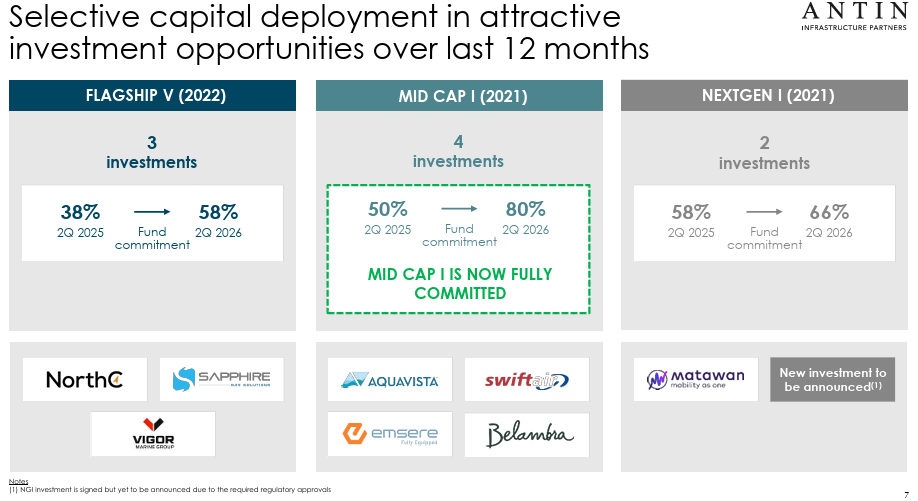
Flagship V, a 2022 vintage and has deployed €3.6bn of the €10.2bn commitments. This creates frictions with LPs as they have allocated funds to this strategy, while not receiving capital calls.
The strategy will likely face difficulties during the next fundraising cycle. This is affecting the entire industry. Other PE firms are creating continuation funds, which in my opinion, are a worst outcome for investors.
Antin did it with Fund III-B in 2020 and the results are clear, it’s the worst performer of all its funds.
The main issue is the delay in investing, which implicitly affects the future fundraising period of the next two funds:
For Fund VI, it implies a delay in future fundraising of 1-2 years
But, it will also impact Fund VII, as the current fund will take longer to divest.
It seems the company found its sweet spot in the mid cap fund, deploying significant capital in the last years, but it’s not happening with fund VI, which 4 years after inception, it has just deployed 60% of the committed capital.
Considering all these factors, the most conservative approach is to model Fund VI for 2028 and reduce the size to €8-10bn.
4. Forget about the first carried interest from Fund III-B
Fund III-B is below target, which means that is highly unlikely shareholders will benefit from the first carried interest.
While this has not a material impact on valuation, we feel that taking the most conservative approach with carried interest is the right approach and we are adjusting some of the future targets considering the delays in Fund V.
While management still reports €500 million of potential carried interest, I’m slightly adjusting the figures to remain conservative and excluding any carried interest from Fund III-B.
5. Midcap Strategy: Should we be worried?
The launch of Mid Cap II has been delayed to the end of the year. Management cited that wants to maximize efficiency to LPs by making coincide the fund activation with the first investment.
Management cited that they have commitments held in escrow, but didn’t provide further details on fundraising activity.
This adds some uncertainty, but the outcome is likely to be seen by the end of the year. What seems clear is that investors are focusing on deployment times and want to avoid having their funds committed through longer periods.
6. Have Operating Expenses gone too far?
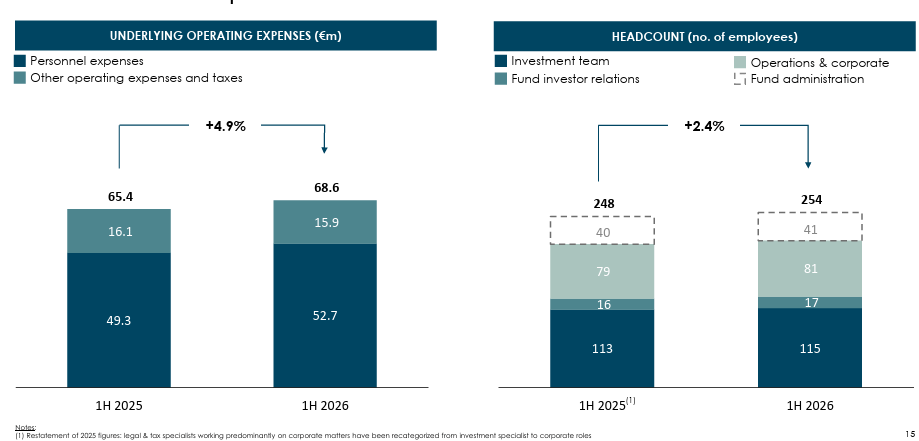
When CIC's Arnaud Palliez asked whether they'd launch cost-control measures given the fund delay, Walid was explicit that the delay "should not trigger any cost actions." The framing was that Antin has spent recent years building a scalable platform (investment teams, specialist functions, fundraising, operations), so cost growth is now naturally decelerating and operating leverage is starting to show — but they'll keep investing ahead of the next fundraising cycle.
Since the IPO, the headcount has nearly doubled, with personnel expenses increasing significantly each year. This has not been followed by a rise in management fees from fundraising, eroding margins over time.
While too soon to judge this, there is currently a misalignment between size of the teams and the size of the assets under management.
In a year with no exceptional developments, personnel expenses grew by +6.9%.
7. During September 15th, multiple partners sold shares, partly increasing the liquidity of the stock
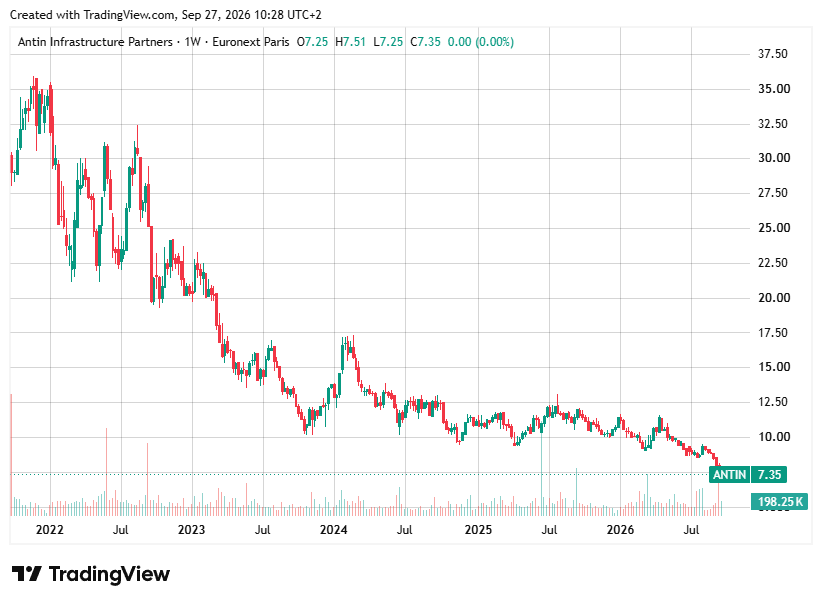
Adding to this weak performance, during September 15 a group of current and former partners placed a large block of shares at a material discount to the prior market price.
The selling group placed 5.0 million Antin ordinary shares, equal to roughly 2.8% of the company’s share capital.
The shares were sold through an accelerated bookbuild at €7.18 per share, for gross proceeds of about €35.9 million.
Antin had closed the preceding session at €7.98, so the placement price represented a 10.03% discount to the prior close.
In response, the listed shares traded around €7.54–€7.55, down 5.5% intraday.
It’s a bad timing, and a bad signal, considering share price it’s at historical lows. A 10% discount signals that there is no appetite for Antin — for whatever the reason.
Some members of the Executive Committee, including Alain Rauscher, Chairman and CEO, purchased c.1.4 million shares at the offering price.
Antin purchased c.0.7 million of its own shares at the offering price, pursuant to its share buyback program authorized by Antin’s shareholders at the Annual General Meeting of 10 June 2026.
The Sale follows the second expiry of the IPO lock-up, during which 25% of the shares held by the concert of partners were released. The Sellers and the members of the Executive Committee who placed an order in the Sale have agreed to an additional 90-day lock-up, subject to certain customary exception
This added extra pressure to the stock price, which is at historical lows.
8. Forecasting the future is more challenging than ever
On one side, we see headcount increasing in the last years, with the message that the company is preparing for a new cycle of growth.
On the other hand, investment activity is weak and might impact the future fundraising cycle.
Overall, fundraising activity is positive in the market, and firms are raising more funds than in past years.
However, the market is clearly pricing a deterioration of Antin’s business, and frankly, the company is not delivering to contradict this argument.
9. Market is anticipating a negative scenario with a massive multiple re-rating over the last years
Antin stock keeps declining, which raises the question of whether this is a value trap or not.
As seen in the chart below, stock performance is not matching the evolution of fundamentals of the company. Recent performance is driven by a huge multiple re-rating.
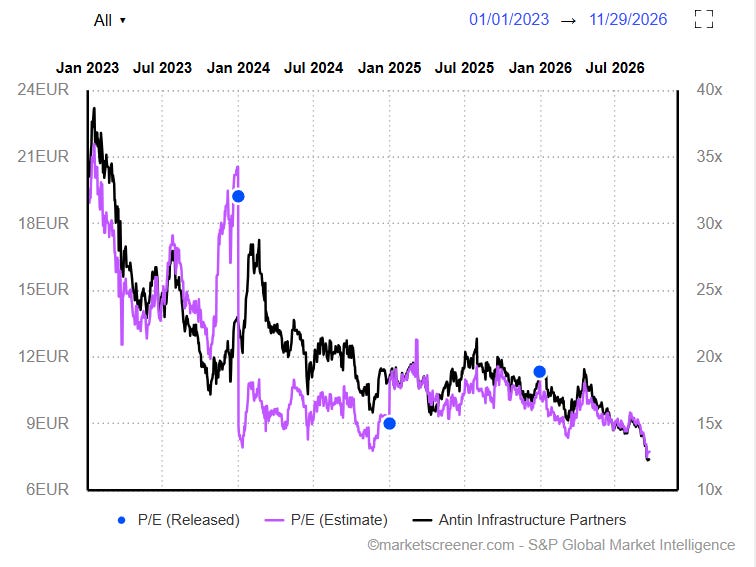
Consensus analysts believe that the company will earn €100m during the next year, and €150m in 2028. However, what the market is saying to us is that this company is no longer a high quality private equity firm.
There are factors that impact this view:
First, Antin is a small company in the stock market, mainly due to low liquidity. With c.16% of free float and €1.3bn of market cap, this means that only €200 million is available.
This illiquidity generates high volatility — for the good (in 2021) and the bad (right now).
10. At current valuation investors get a c.9-10% dividend yield
Dividend at €0.7 per share is confirmed — at least for this year representing a dividend yield of 9-10%.
But, depending on the outcome of the fundraising cycle of the next 2-3 years, this dividend might not be sustainable.
There are too many uncertainties, and either the market has gone too far, or EPS is expected to decrease by 50% following the next fundraising cycle.
11. At this stage, we need to model 3 different scenarios to quantify the outcome
I build three different cases:
Conservative scenario: the company faces 5-year cycles, compared to 3-4 years historically which lead to a new fund every 6 years; lower fund size compared to current funds; No future NextGen funds.
Base case: Fund life cycles moderate and company launches new funds every 5 years (4 years to invest a fund), and fund size is maintained across the 3 strategies
Aggressive case: Same as base case but with an improvement in fundraising (+10% fund size in first cycle and +20% in the second cycle)
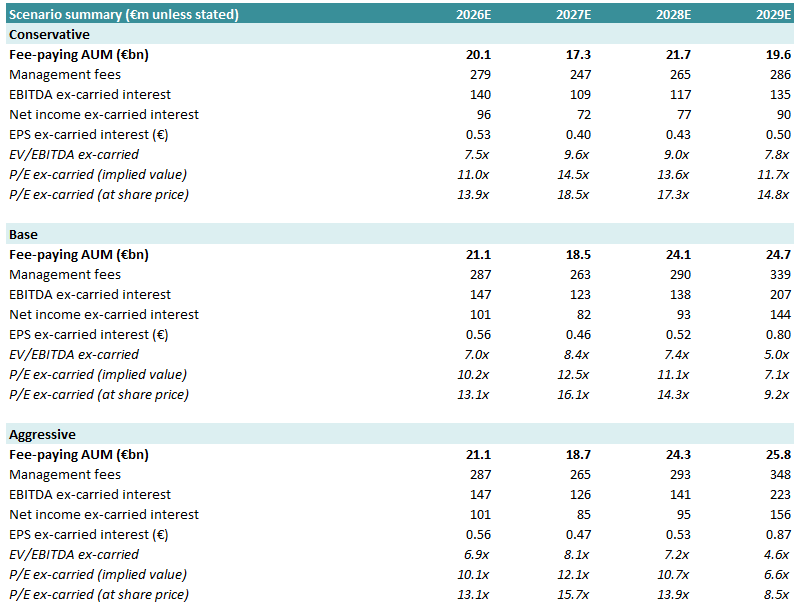
In a conservative scenario, current price will reflect a P/E ratio of 12-14x, excluding the value of carried interest (which I assume less than 50% of what management reports).
In the remain scenarios, P/Es are very attractive.
12. Expected Returns
Under these scenarios, I get very attractive IRRs.
The model assumes an exit P/E ratio of 15x earnings excluding carried interest, and the present value of expected carried interest, which is less than 50% of the potential value.
Even in the conservative scenario, the IRR is double digit:
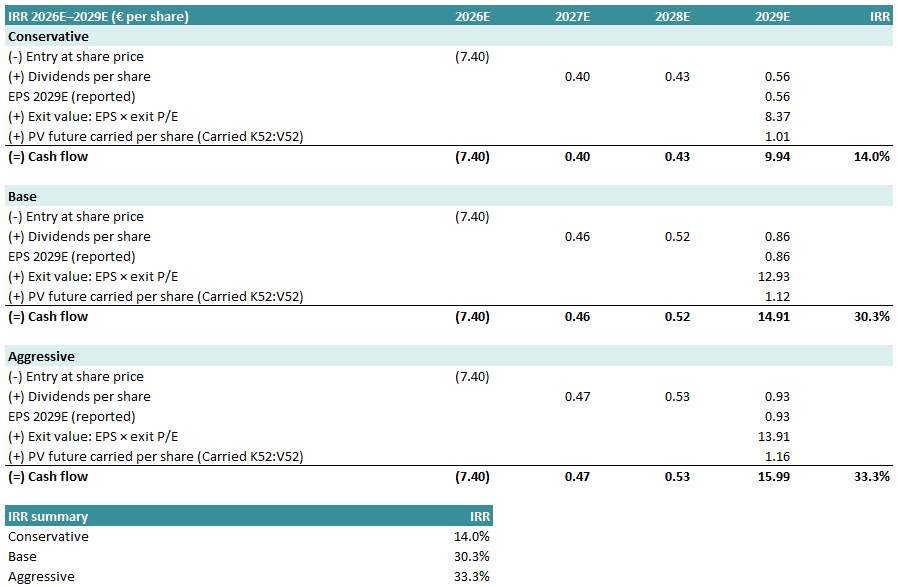
However, the conservative case is not a worst case scenario. Under a worst case scenario, returns can still be negative from here.
Note: this model is available upon request.
13. My views and conclusions
I bought Antin stock more than two years ago at an average price of €11.4 a share. Since then, the stock is down by 35% — the worst performer of my portfolio. Including dividends, performance is -26%.
Under a conservative scenario, expected share price will be c.€9.4, 18% lower than my investment. Adding €1.3 of expected dividends, leads to -7% return, which adding back the current dividends received will imply a neutral return. This means recovering the money.
In the rest of scenarios, implied returns are of 30-50%, which are still significantly below my expectations, as the implied IRR over a 5/6-year tenure period will be low.
The delays in the fundraising cycle have affected the temporary value of the company. While it can increase in the next 2-3 years,
Selling now at the lowest point I think it’s not a good solution. The high volatility can lead to a partial recovery over the next weeks, and it seems unlikely that the stock can keep declining, considering it’s trading at a very conservative valuation.
This bad performance is materially impacting the performance of my portfolio, but I believe it’s worth waiting, although the uncertainty is high.
Since we can get our money back and earn a decent return in the coming quarters, I decided to keep it as it is.
Time will tell if being patient will have a positive outcome.
14. Lessons learned
When a company is facing some headwinds — note that Antin is not fighting for survival, but rather to see if it will keep growing — it’s very important to review the main drivers of its business and be extremely conservative.
These are some of the mistakes I made.
But the most important thing is that whenever we have doubts, always factor the most conservative scenario.
More specifically for Antin and the Private Equity industry:
A fundraising cycle depends on performance and distributions.
First, Antin is not returning all the capital back from prior funds. This was forecastable as they don’t do much exits every year. We could have reached the conclusion that Fund III will certainly be extended.
Second, extending the life of a fund generally implies lower returns, as the IRR is highly dependent on timing.
Third, and most important, before starting fundraising of a fund, it’s critical to invest the current one. Antin faces huge delay in Fund V, and while deployment of capital can be done fast if needed, it was also clear that by the end of 2026 it was very challenging to have all capital deployed.
The lesson is clear: if there are challenges, always forecast the most conservative scenario. For Antin, it’s a reduction of AUM in the next fundraising and delays. While it might not materially impact the valuation,
Best,
Phil
This is not investment recommendation.
Asymmetric Ventures

Disclaimer:
Thanks for the update Phil. My position is still tiny so I can practice "patience et longueur de temps" with this stock.