

Disclaimer. Please read full disclaimer at the end of the page before reading the report. This publication is only for information and entertainment purposes. It doesn’t constitute financial advice.
The information provided in this blog is for informational purposes only and should not be considered as financial, investment, or professional advice. The valuations and analyses presented here are based on publicly available
Executive Summary
Note: the following content do not constitute investment recommendation.
Introduction: an opportunity in the UK in a very resilient sector
CVS Group, is a veterinary provider in the UK and Australia.
In 2024, the CMA (UK’s watchdog), launched an investigation on the UK veterinary market.
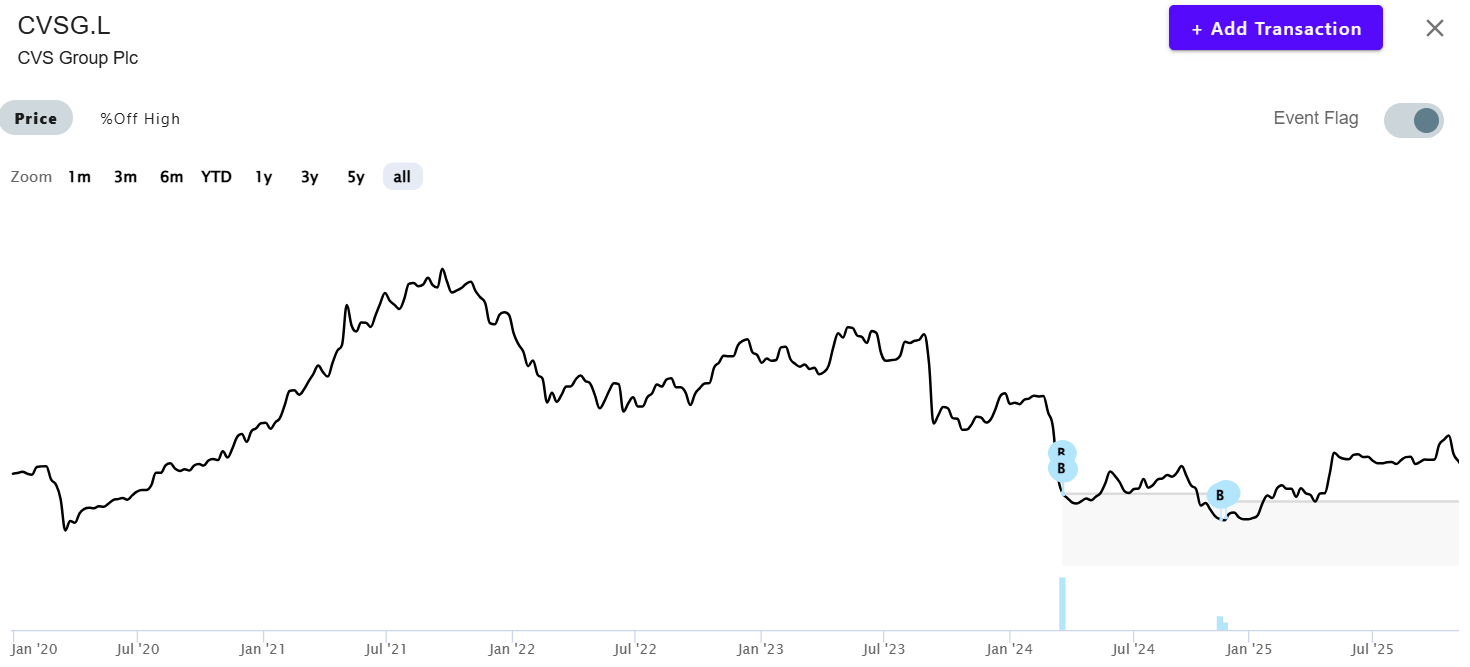
Stock immediately fell by more than 50% following the news.
Investment thesis relied on the market overreaction and that worst case scenario was not likely.
We bought shares at the time when the narrative about the company was most negative, at an average price of £9.5 per share.
Flash-forward 18 months: risks are very limited, and company is better than it was. Current gains are just +10% (reaching +50% some weeks ago), presenting a new opportunity.
CVS Group - do not confuse with the US healthcare company - provides veterinary services across the UK and Australia
The company owns 425 practices in the UK and ~50 in Australia.
Company is rapidly expanding in Australia, where they entered ~2 years ago.
The company generates £670 million in annual revenue, of which 89% comes from Veterinary practices, 4.5% from laboratories, and 6.5% from their online shop Animed Direct.
The UK Veterinary market is large and consolidated between large corporates, including CVS
The UK has one of the largest pet populations, with an estimated of 36 million pets.
There are 5,500 practices (i.e., one practice per 6,500 pets).
In the UK, large corporate groups own ~60% of the market share. CVS has a 10% share. Some of the groups are backed by large private equity firms such as EQT.
The CMA Investigation: constant delays and a final resolution expected by May 2026, nearly 3 years after
Initially, the CMA launched a market review in September 2023.
After their initial review, the CMA launched an investigation in May 2024 to assess whether veterinary practices were charging excessive fees to pet owners.
Similar to every investigation by public authorities, their initial claims were a statement against free market, claiming that companies were earning more than they should.
Putting things into perspective: CVS Group earns an EBITDA margin of 20%, which is significantly below other critical services for a country such as fiber, where telecom operators earn significantly higher margins.
CVS and many other groups invest millions every year in new equipment, refurbishing practices, etc.
The statutory deadline has been pushed several times, and now it is expected to end in May, which is three years after their initial review - delays that are not reasonable and affect very negatively the market.
Initial claims by the CMA seemed excessive and market feared the worst case scenario
Concentration - Was the sector excessively concentrated between corporates with high market shares? Could this force large groups to divest their practices?
Pricing limits? limiting referrals, prescription medicines, etc.?
In December 2024 I published my investment thesis on CVS: the CMA remedies couldn’t go as far as expected.
We analyzed the remedies proposed and past resolutions: market was overreacting
Market feared forced sale of clinics. We analyzed the concentration and market share of CVS and that was not realistic.
We analyzed past remedies imposed by the CMA - Market was fearing unprecedent measures.
Overall, the investment thesis relied that remedies will have a limited impact on CVS, as the company didn’t dominate any specific region, nor was earning above-market margins.
CMA has published the provisional remedies, which are in line with the investment thesis:
Provide a price list for specific services and treatments on the websites, and be clear if the practice is part of a large group.
Provide itemized bills for treatments and services.
Provide a written estimate for treatments that could reasonably be expected to cost more than £500.
Inform pet owners that they can get written prescriptions and that medicines may be cheaper online. Cap the fee for providing a written prescription at £16.
Requiring vets to give pricing breakdowns for pet care plans.
Remedies will have low-to-moderate impact on CVS, something largely discounted by current share price
Choosing a vet is a function of convenience and confidence. Price is not the major factor in the decision.
Remedies will not include force sales, and further M&A will be allowed.
Main issue remains prescription medicines. This is mitigated by the fact that consumers can acquire them online (even through CVS website Animed), and that some others are required immediately.
Remedies set will have some negative impact on CVS in the short-term, but will also arise some opportunities to further consolidate the industry. M&A will be posible.
This impact will be offset during the next years with the development of the Australian business and continued investments in their practices.
How much revenue is at risk?
Main risk is currently the prescription of medicines. CMA wants to encourage people to buy medicines online.
CVS generates 20% of the revenues from medicines.
There are mitigants to CMAs potential decision: CVS owns an online store and many medicines require immediate acquisition.
CVS will still be able to charge a fee for providing a written prescription.
CVS is well positioned to capture further growth, from both organic and inorganic opportunities
Company’s performance remains good. Revenue from veterinary practices keeps increasing every years, with a 2025 more challenging, but still delivering positive growth.
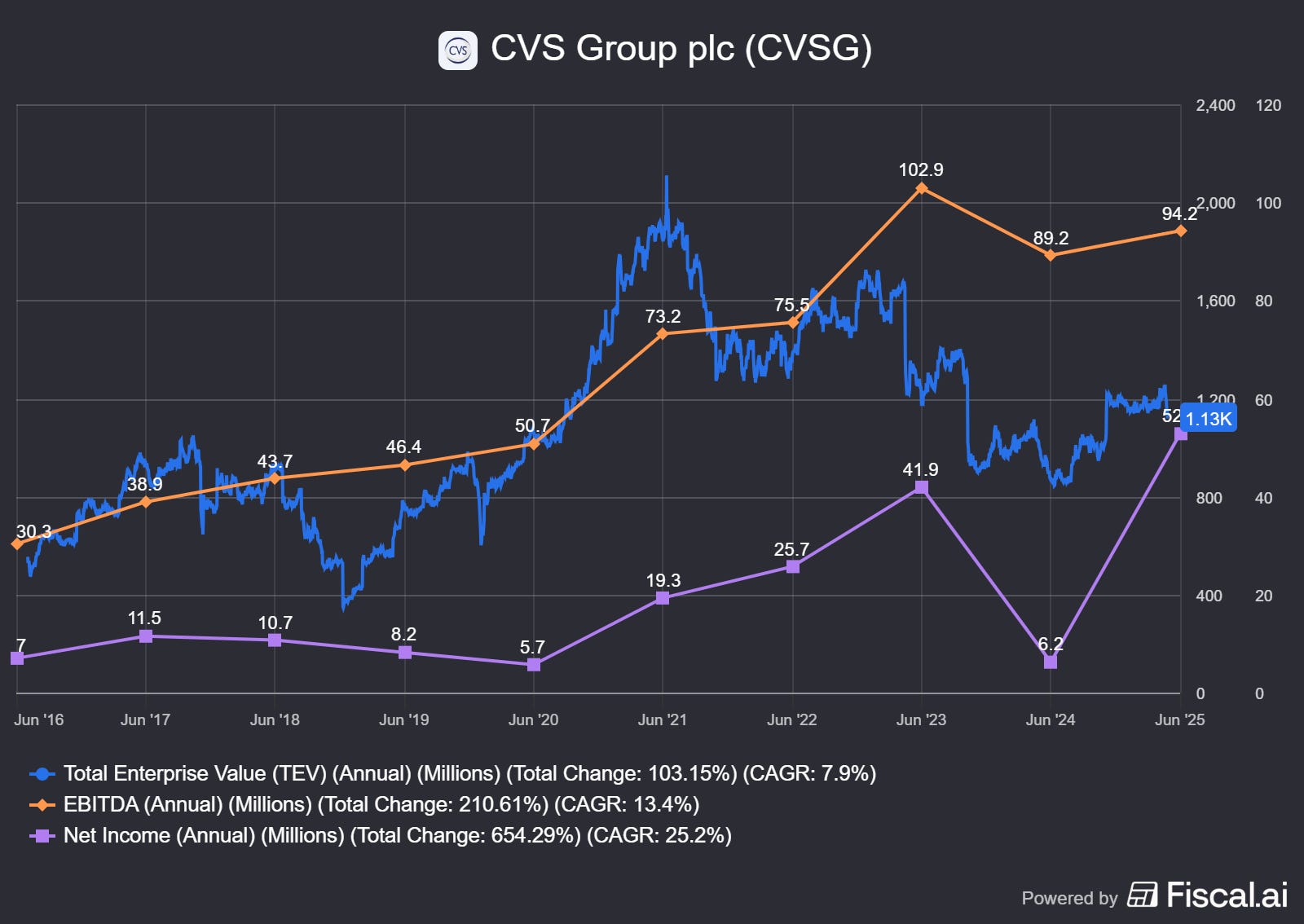
EBITDA margin stands at 20%.
Leverage is low, at 1.2x excluding leases.
FCF stands at 10% of the revenue.
The Australian market opportunity will develop a new equity story
Less regulated market, escaping current European regulations.
A rich and stable economy, with similar culture.
An under-developed veterinary market that allows for consolidation.
CVS remains a very interesting opportunity, yet share price is down by nearly 20% in the last weeks
Company trades at an EV/EBITDA of 8.5x, significantly lower than what private equity firms were paying 5 years ago (12-15x EBITDA).
Price-to-FCF stands at 12x, excluding expansionary capex.
Company has decided to exit the AIM (UK’s alternative market) and move to the London Stock Exchange.
The Main Market generally attracts a broader set of institutional investors compared to AIM. CVS Group’s board say the move will “improve trading liquidity”.
Company is launching a £20 million share buyback program (2.3% of the market cap), a good movement from capital allocation perspective.
Market valuation is completely disconnected to real risks from CMA and from actual
In this post I will do a deep review of the current situation, the CMA review, and the current valuation for premium only subscribers.
Thank you,
Phil from Asymmetric Ventures

CVS Group Annual Update
Content:
Main Highlights of recent performance
Annual review of 2025 results
Valuation
CMA’s Provisional Remedies
Conclusions
