


LVMH Q3 2026: Reading the Quarter
Disclaimer. Please read the full disclaimer at the end of the page before reading the article. This publication is for information and entertainment purposes only. It does not constitute financial advice.
Please remember that nothing in this post is an investment recommendation.
Index:
I. Introduction
II. Financial details
III. Segment performance
IV. CFO prepared remarks
V. Call themes (Q&A)
VI. Recent news
VII. Competitive and industry context
VIII. What to watch from here
IX. Conclusions
I. Introduction
LVMH reported third-quarter 2026 revenue on October 12th, after the close of the Paris market, followed by a conference call led by CFO Cécile Cabanis and Director of Financial Communications Rodolphe Ozun. As usual for a quarterly update, the company only reported revenue; profit and margins will be published with full-year results.
Q3 revenue was €18.5bn, up 1% organically and 1.2% on a reported basis. It was the first quarter in which currency turned into a tailwind (+2%) after five consecutive negative quarters, partly offset by a -2% perimeter effect from the DFS disposals and the sale of Marc Jacobs (closed September 1st).
The headline group figure was close to expectations, but the composition was not. Fashion & Leather Goods declined 5% organically, against a consensus of roughly -1.6% to -1.8%, as a sharp, macro-led deterioration in Chinese consumer sentiment hit the division most exposed to the region. All other business groups grew: Selective Retailing +8%, Wines & Spirits +6%, Watches & Jewelry +6% and Perfumes & Cosmetics +1%.

Management’s prepared remarks focused on three messages:
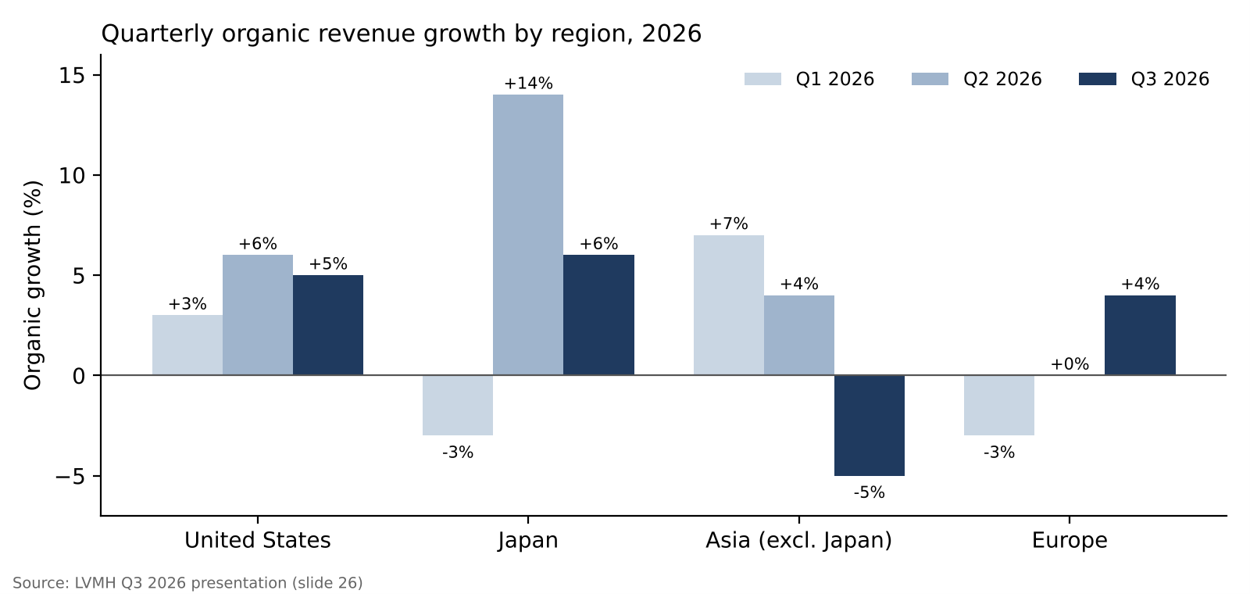
Resilience from portfolio and geographic balance: the US (+5%), Europe (+4%) and Japan (+6%) more than offset a mid-single-digit decline in Asia excluding Japan.
China as the swing factor: Chinese clientele was down mid-teens in Fashion, with onshore spending down double digits; September exit rates improved.
Self-help over drastic measures: creative renewal, product newness and in-store experiences, explicitly ruling out price cuts at Louis Vuitton (i.e., no changes in prices are expected).
The shares closed at €381.20 on Friday October 9th, roughly 40% below their level at the start of the year. Because the release came after the close, the market reaction will be visible on October 13th.
At a glance
Revenue Q3 €18,504m: +1% organic, +1.2% reported (Q2: +3% organic)
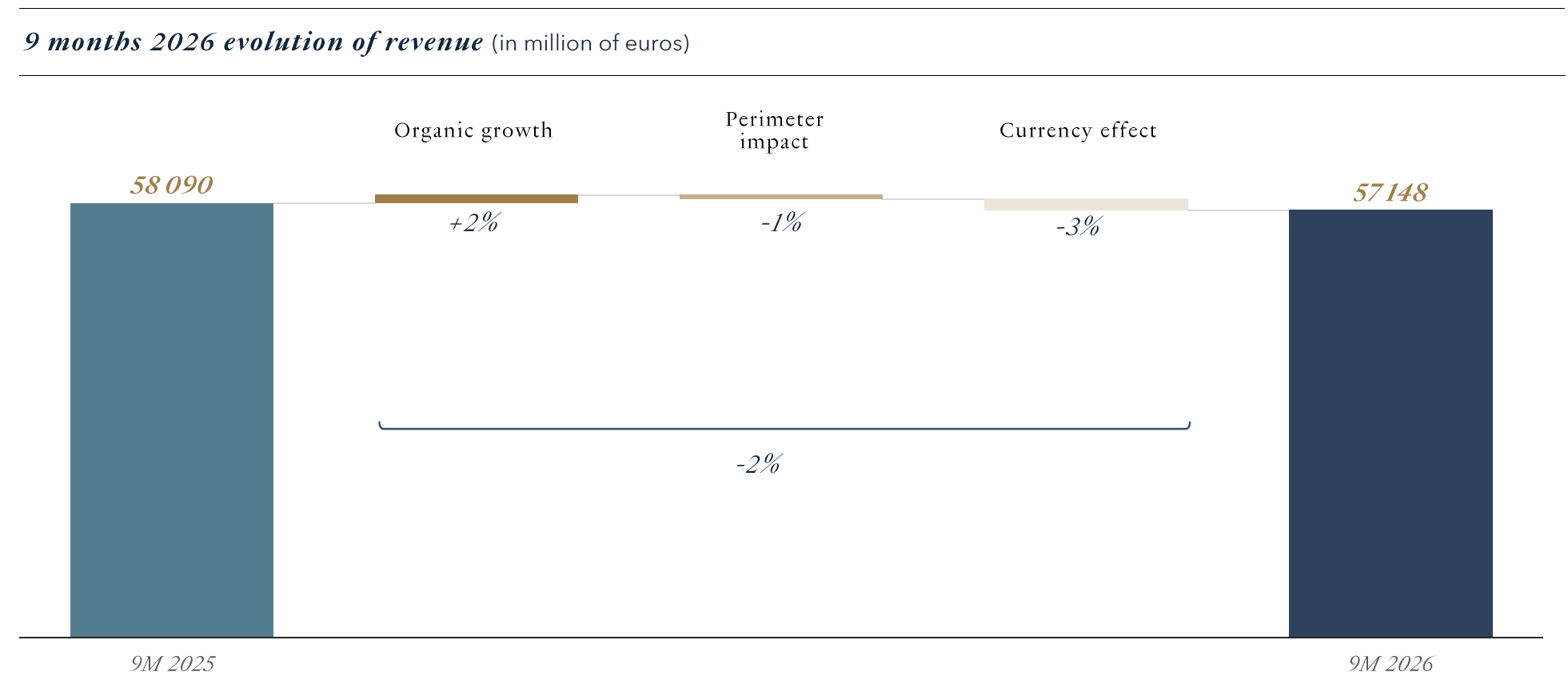
Revenue 9M €57,148m: +2% organic, -1.6% reported (FX -3%, perimeter -1%)
Fashion & Leather Goods Q3 €8,245m: -5% organic (Q2: +1%); 9M -2%
Watches & Jewelry Q3 €2,500m: +6% organic (Q2: +11%); 9M +8%
Selective Retailing Q3 €4,070m: +8% organic, best quarter of the year; 9M +6%
Wines & Spirits Q3 €1,429m: +6% organic, third straight quarter of mid-single-digit growth
Perfumes & Cosmetics Q3 €2,008m: +1% organic, in line with group
Regions Q3 (organic): US +5%, Japan +6%, Europe +4%, Asia ex-Japan -5%
Share buybacks 9M: €2.3bn
Interim dividend €5.50 per share, payable December 3rd, 2026 (declared with H1 results)
II. Financial details
Revenue bridge
Organic growth +2% 9m 2026 (+1% Q3)
Perimeter (DFS disposals, Marc Jacobs) -1% 9m 2026 (-2% Q3)
Currency effect -3% 9m 2026 (+2% Q3)
Reported change -2% 9m 2026 (+1% Q3)
Revenue by business group
As explained before, very solid performance from Wines & Spirits, Watches & Jewelry, and Selective Retailing. However, Louis Vuitton significantly underperformed the rest of divisions, something that the market does not tolerate.
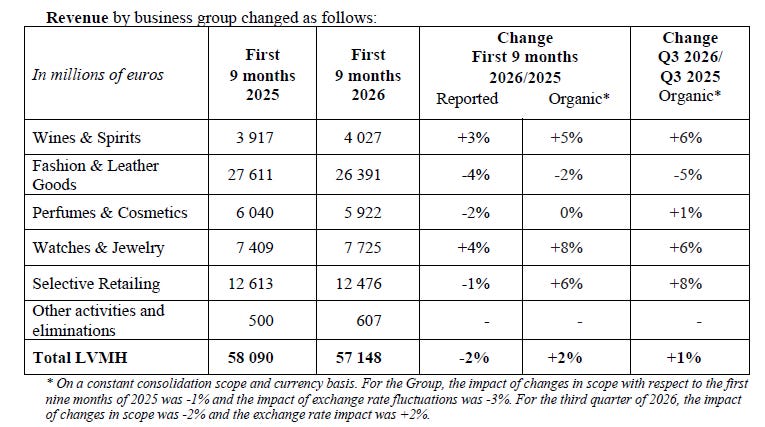
The immediate view is to consider these results as bad because of the decline in Louis Vuitton. However, all divisions except Fashion & Leather are growing at mid-single-digits, which shows how strong the portfolio of brands is.
Wines & Spirits keeps a solid pace at +5-6% throughout the year.
Fashion & Leather was the big surprise.
Perfumes & Cosmetics is having a difficult year, but came to positive growth again, even if modest +1% organic growth.
Watches & Jewelry had a “modest” quarter compared to the previous ones, and is delivering a very solid +8% organic growth (part of it explained by the increase in gold prices)
Selective Retailing keeps accelerating revenue, from +4% in Q1 to +8% in Q3
Overall, these are good results, except for Louis Vuitton.
Organic growth by region
US remains solid at +5% organic growth
Europe came with a surprise +4% organic growth, leaving the year flat
Asia (excl. Japan) was expected negative for the quarter, but not at -5%.
The geographic mix over nine months was unchanged versus 2025:
Asia ex-Japan 27%,
Europe 26% (France 8%, rest of Europe 18%),
the US 25%,
Japan 8% and
other markets 14%
LVMH performance was in line with consensus, except for Fashion and Leather

III. Segment performance
Wines & Spirits — continued recovery
Q3 revenue €1,429m, +6% organic (+7.4% reported). 9M €4,027m, +5% organic.
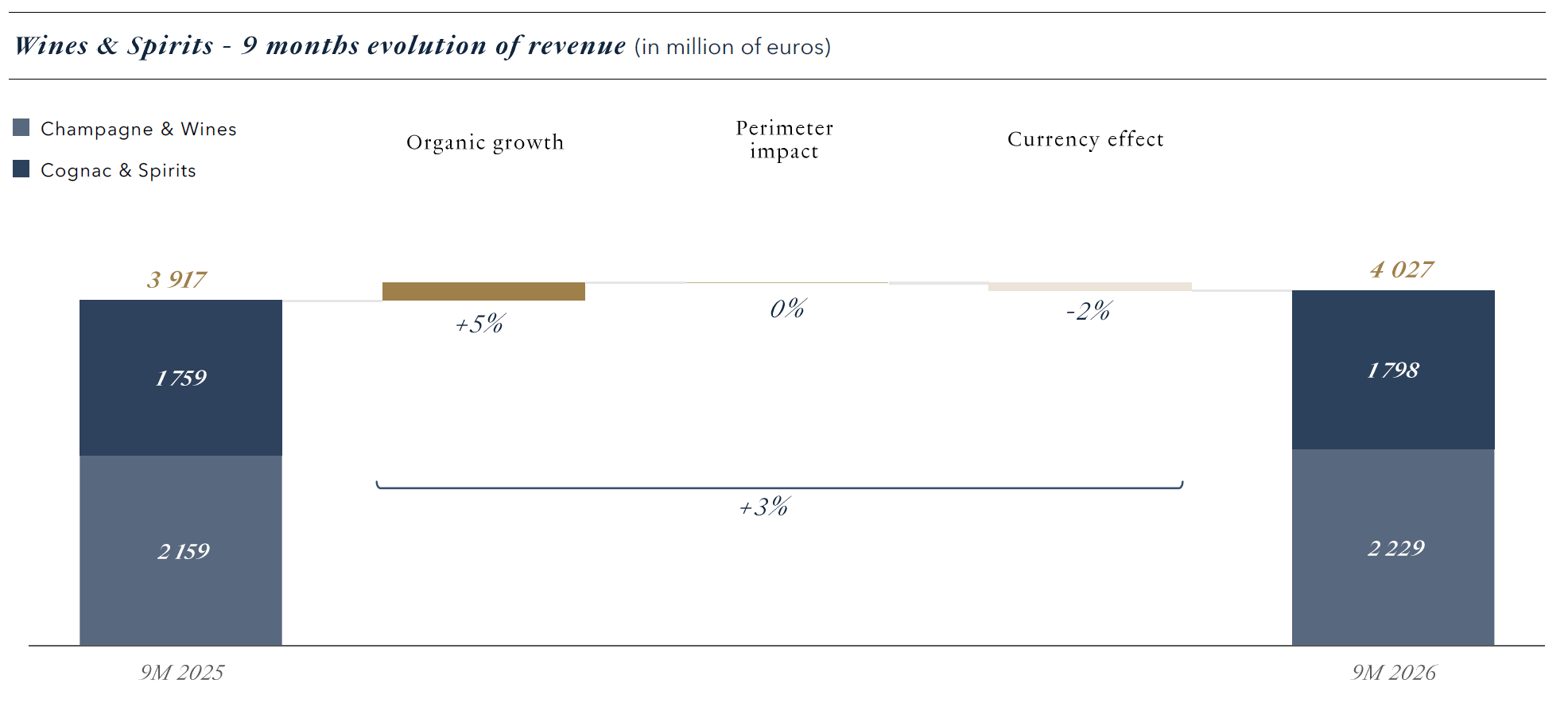
The positive trend seen in the first half continued and accelerated modestly.
In champagne, all key brands contributed, driven by Europe, Japan and travel retail, with Dom Pérignon and Krug outperforming and generating a positive mix effect. Year-to-date, champagne benefits from low-single-digit volume growth and a low-single-digit price effect. Moët & Chandon is in its second season as Official Champagne of Formula 1. Other wines enjoyed a strong European summer season, Provence rosé continued to progress and Chandon benefited from US demand and the new low-alcohol Garden Spritz range.
In cognac, Hennessy continued to improve in Q3, driven by China, travel retail and Europe, with good momentum in VSOP. In the US, Hennessy launched a VS ready-to-serve cocktail range; management described it as early days but noted it attracts both existing and new consumers. Belvedere and Glenmorangie also grew. Cognac & Spirits revenue was up 10% in reported terms in the quarter, the strongest reported growth of any sub-segment.
On margins, the CFO noted that Wines & Spirits will receive the benefit of a weaker euro later than other divisions because of the time stock spends in inventory.
Fashion & Leather Goods — China drives a sharp deceleration

Q3 revenue €8,245m, -5% organic (-3.0% reported). 9M €26,391m, -2% organic (-4.4% reported).
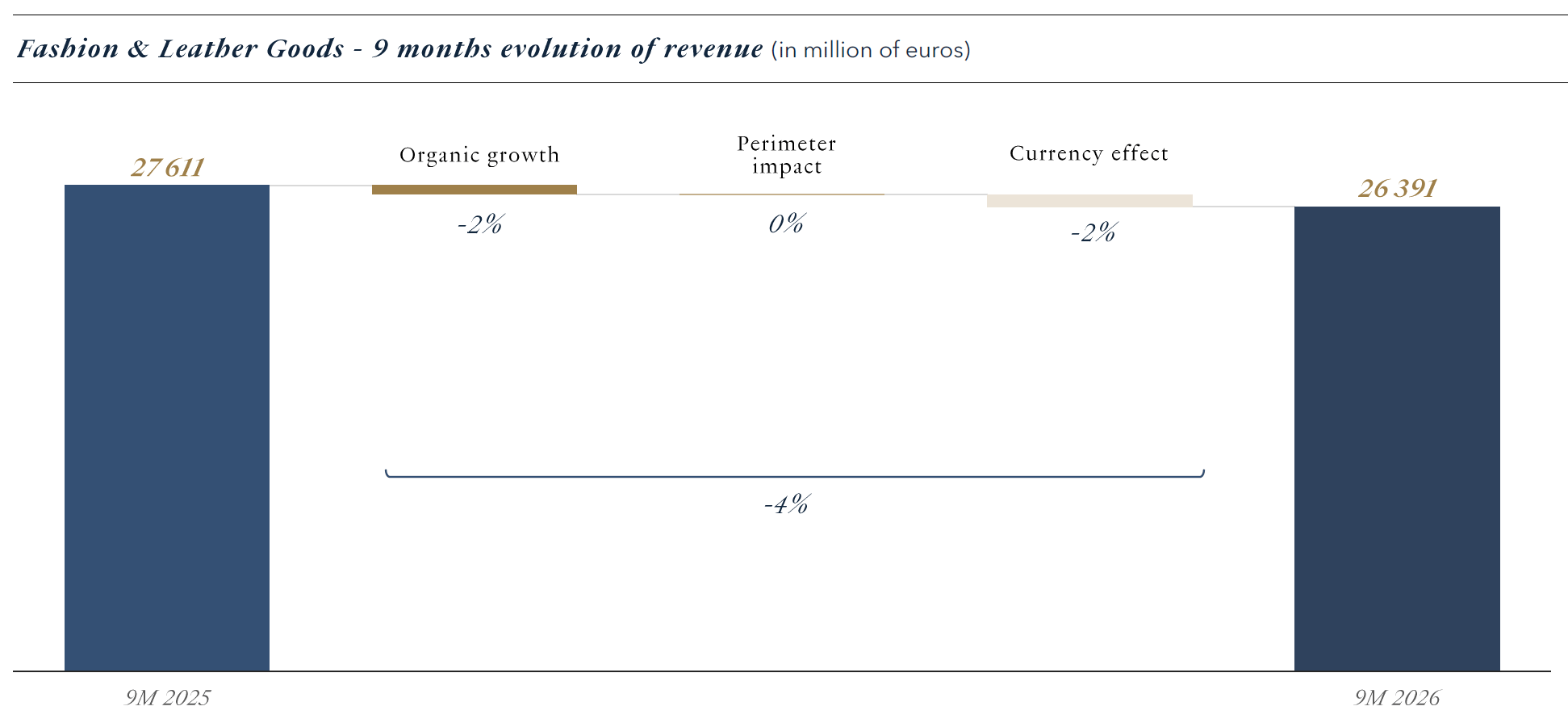
The division went from +1% in Q2 to -5% in Q3, a six-point swing. Management attributed most of the deceleration to Chinese clientele, with US demand still growing and Europe and Japan improving versus the first half. The clientele breakdown provided on the call:
F&LG / clientele (Q3, per CFO):

Louis Vuitton was slightly below the division average in the quarter.
Its organic growth was also affected by a one-off logistics in the US and transportation disruption at a freight forwarder, which cost slightly more than one point of Louis Vuitton’s organic growth; the CFO said it is behind the company and that it is uncertain whether the lost sales will be recovered in Q4.
Product highlights included the Speedy and its high-end version, the P9 (on waiting lists across markets), recent launches such as the Squire and the Multipass, the new Monogram Emblème jacquard weave (celebrating the Monogram’s 130th anniversary) and the Silktech material.
Ready-to-wear by Nicolas Ghesquière and menswear by Pharrell Williams were described as having good momentum.
A new store opened in China during the quarter and recent flagship reopenings were said to be performing well.
A big problem in China
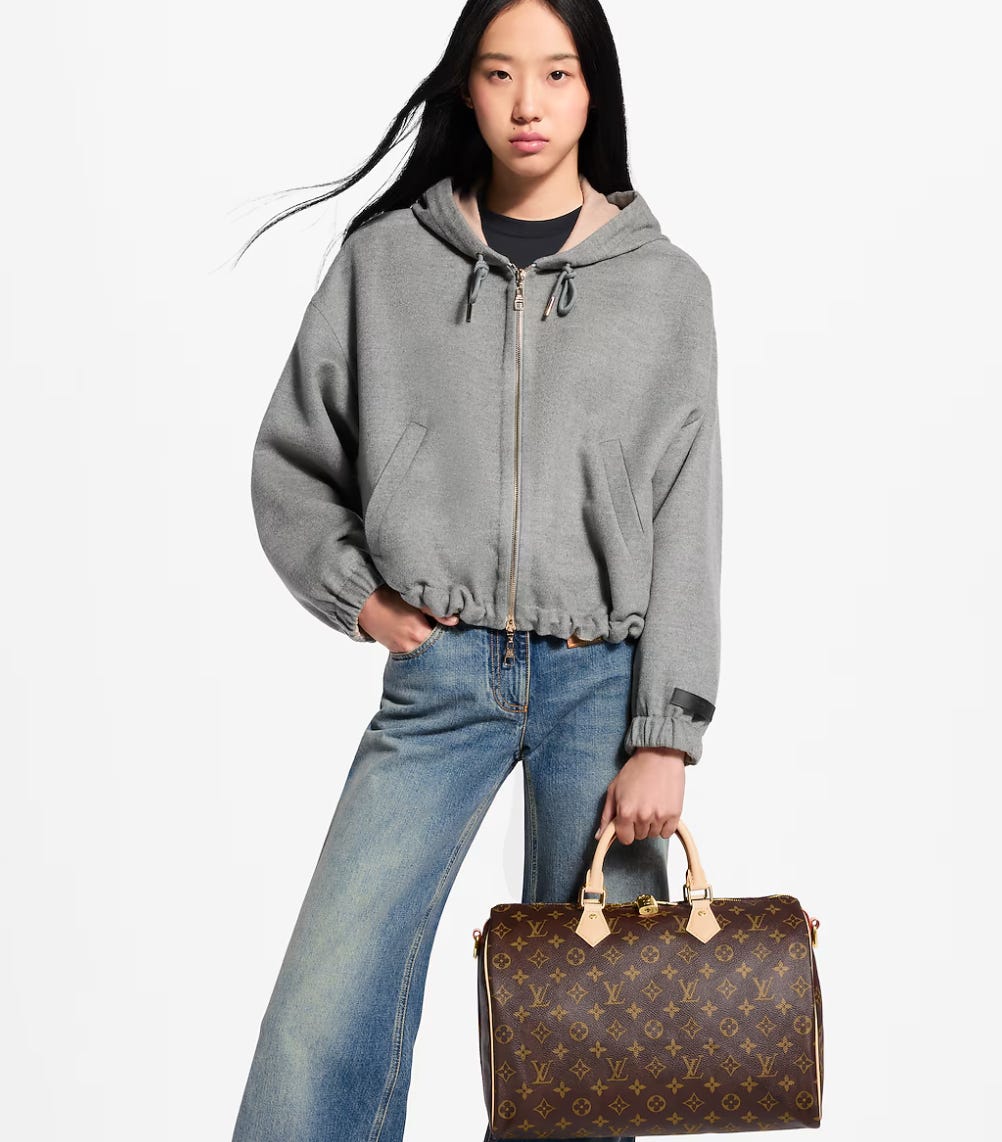
Bloomberg reported that Louis Vuitton’s sales in China dropped sharply over the summer after a social-media backlash. Louis Vuitton had won a trademark case against Molly Tea, a Chinese tea chain whose floral logo resembled the Monogram flower. Many Chinese consumers took the tea chain’s side online, arguing its logo comes from a traditional Tang-dynasty floral pattern.
The figures come from JL Warren Capital, a research firm in Greenwich, Connecticut, whose clients include hedge funds and which tracks international consumer brands with a large presence in China. It estimated Louis Vuitton’s China sales fell about 30% in July and 20% to 25% in August, and projected a smaller decline of around 13% for September. LVMH declined to comment.
The article adds context on peers. JL Warren estimated Gucci’s China sales fell about 20% in July and 10% in August, and Hermès’s about 5% in July and 13% in August. So the weakness wasn’t limited to Louis Vuitton, even before the controversy. The article also notes that Asia excluding Japan was about 29% of LVMH’s revenue in the first half, and that Chinese demand helped push LVMH’s sales and shares to records in 2023.
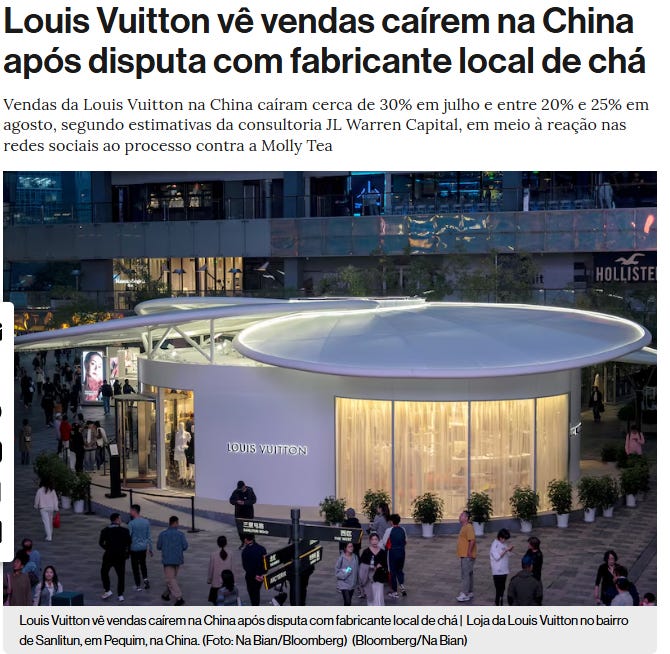
Christian Dior was flat in Q3 and positive year-to-date, with double-digit growth among American clientele year-to-date.
Management said women’s ready-to-wear is the clearest read on demand for Jonathan Anderson’s designs, while bags — more permanent products — take longer to build, citing the Lady Dior, the Toujours (including a Hobo version) and the Cigale at the higher end.
Menswear was described as less advanced.
A new House of Dior opened on Via Monte Napoleone in Milan in September, after Osaka in May.
Among the other Maisons:
Loro Piana and Rimowa continued to outperform.
Celine (Michael Rider) was described as improving fast (translating, still delivering mediocre results), with double-digit growth in shoes and momentum in the US.
Fendi presented the first collections by Maria Grazia Chiuri, with a revisited Baguette doing well.
Loewe (Jack McCollough and Lazaro Hernandez) is seeing pockets of momentum around the Amazona 180 and the new Whisker bag, and
Givenchy (Sarah Burton) has good ready-to-wear performance. Berluti delivered a solid performance.
Marc Jacobs was sold to WHP Global, a great move by LVMH.
Perfumes & Cosmetics — stable, led by historic Maisons
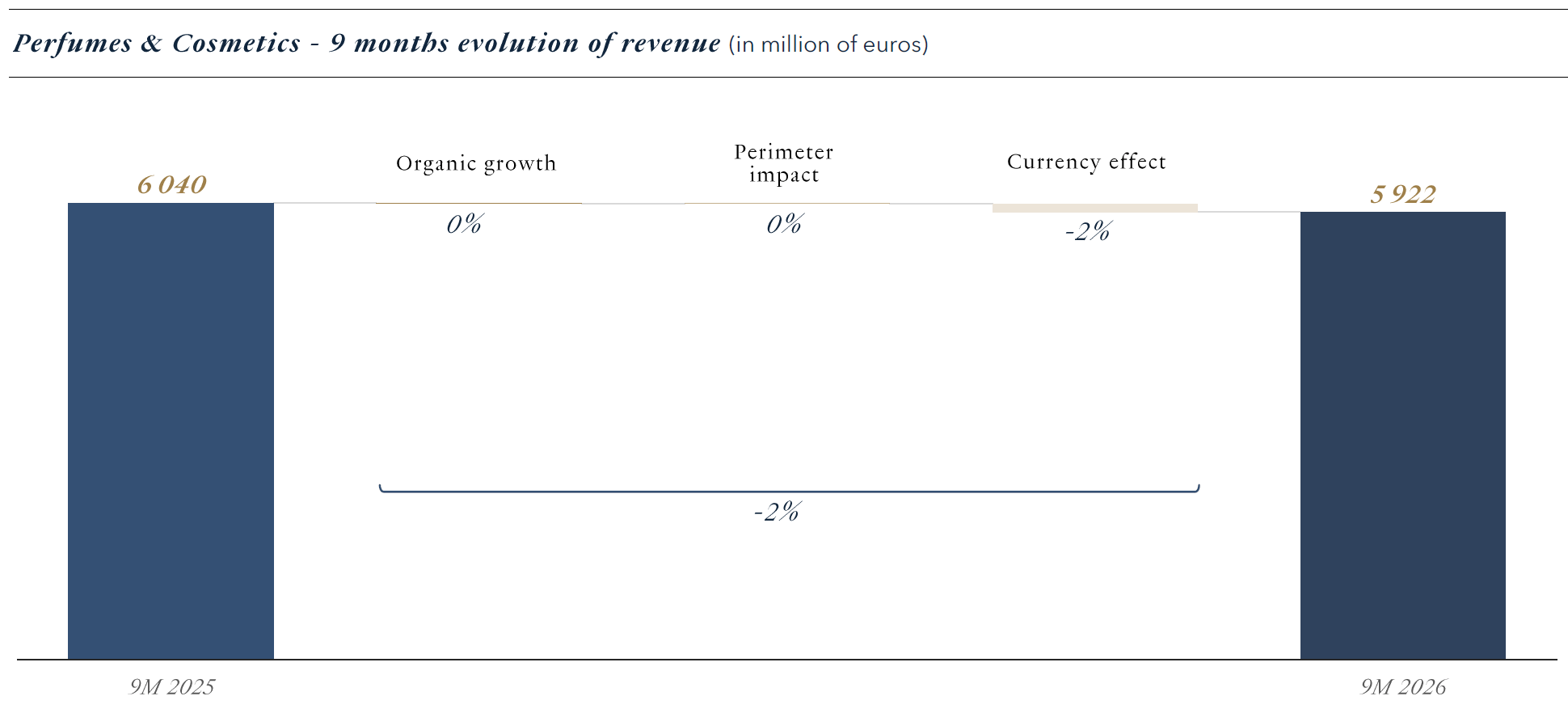
Q3 revenue €2,008m, +1% organic (+2.6% reported). 9M €5,922m, flat organic.
Fragrances remained the main growth driver.
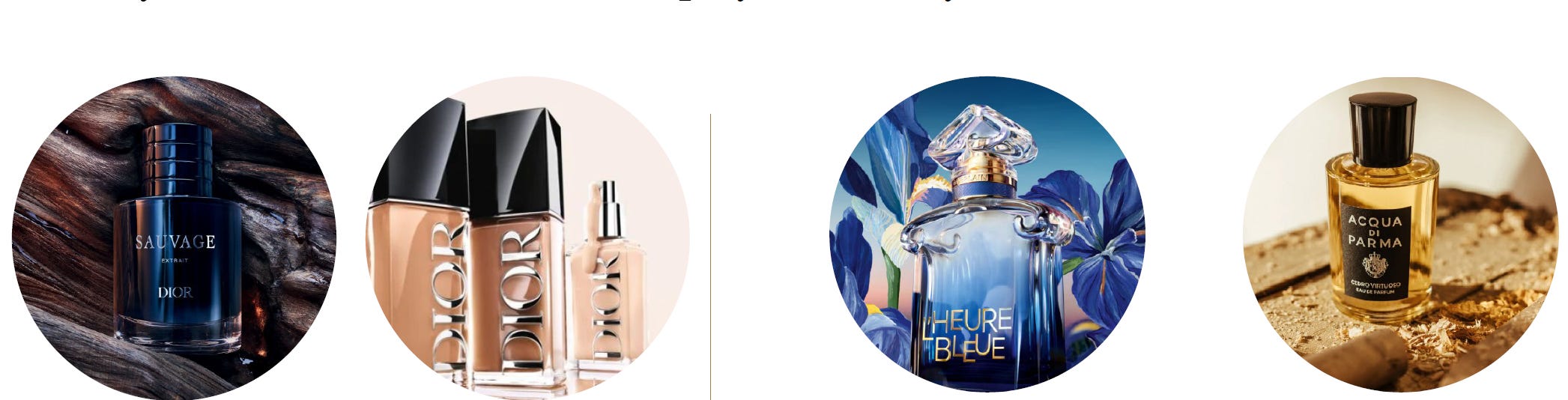
Parfums Christian Dior benefited from J’adore Intense, Sauvage Extrait and eau de parfum versions of Dior Addict, new scents in La Collection Privée, and makeup momentum (Forever, Backstage).
Guerlain saw substantial growth with the L’Heure Bleue launch, the L’Art & La Matière and Aqua Allegoria collections and Rouge G lipstick.
Parfums Loewe and Maison Francis Kurkdjian (Oud collection) also performed well.
By region, Asia and Japan showed good momentum and the Middle East was resilient.
The division appointed a Chief Operating Officer to drive convergence across Maisons in manufacturing, supply chain and purchasing.
Watches & Jewelry — still growing, but slower

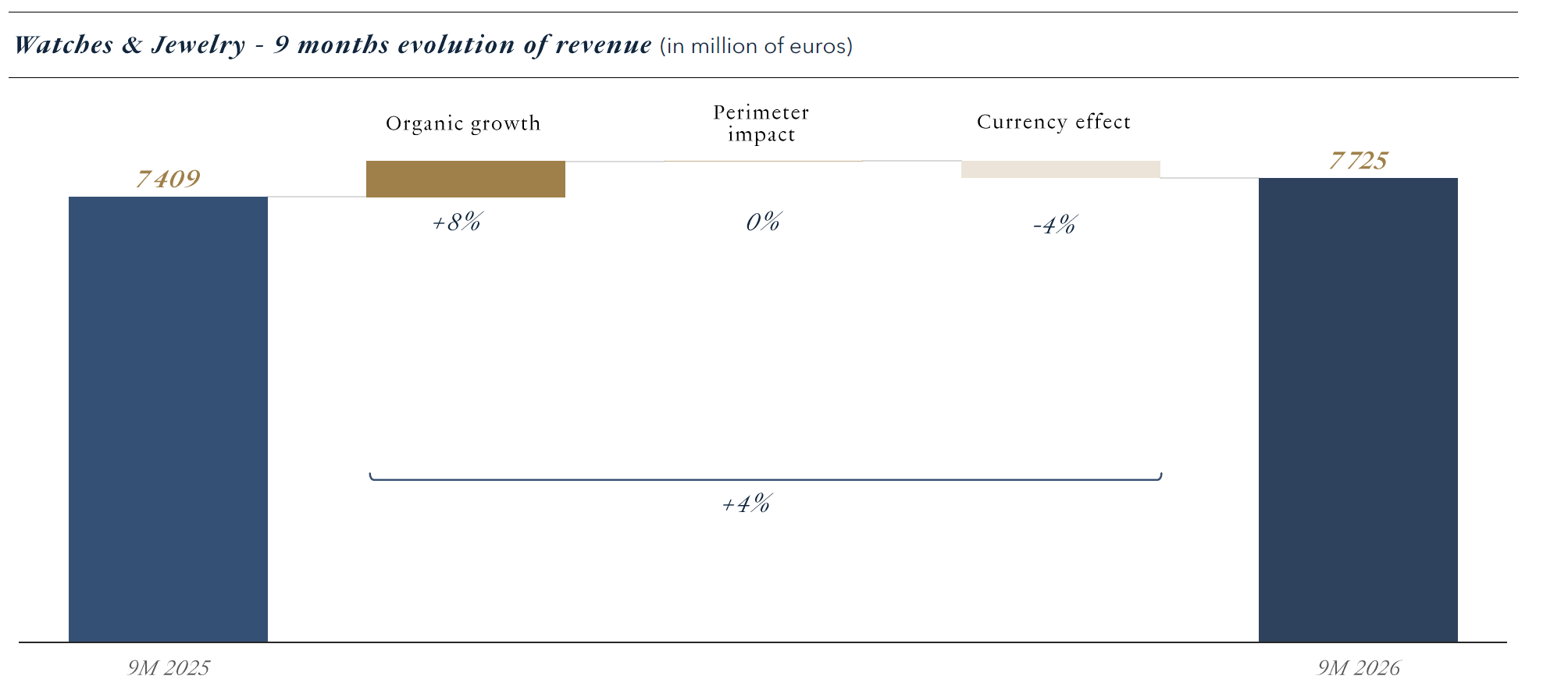
Q3 revenue €2,500m, +6% organic (+7.8% reported). 9M €7,725m, +8% organic.
Growth slowed from +11% in Q2 to +6% in Q3. Management cited three factors:
Weaker Chinese demand,
a slowdown in the US between Q2 and Q3, and
a tougher US comparison basis for Tiffany.
Pricing has been a contributor, linked to higher gold prices; the CFO indicated that price increases should moderate as gold prices stabilise. For Q4, Bvlgari faces a tougher comparison basis, though management said it expects the division to keep growing.
At Tiffany & Co., the HardWear and Knot lines continue to outperform materially, now joined by Sixteen Stone and Bird on a Rock.
About 40% of stores have been renovated and these are outperforming significantly.
The Blue Book 2026: Hidden Garden high-jewelry collection was well received, while legacy lines and silver remain a drag.
Bvlgari showed broad-based strength (Serpenti, Diva, B.zero1), record revenue for the Eclettica high-jewelry line and a first US art installation on the New York High Line. In watches, Hublot named Jeff Koons as collaborator and ambassador and TAG Heuer was Title Partner of the F1 Grand Prix in Madrid.
Selective Retailing — Sephora keeps gaining share
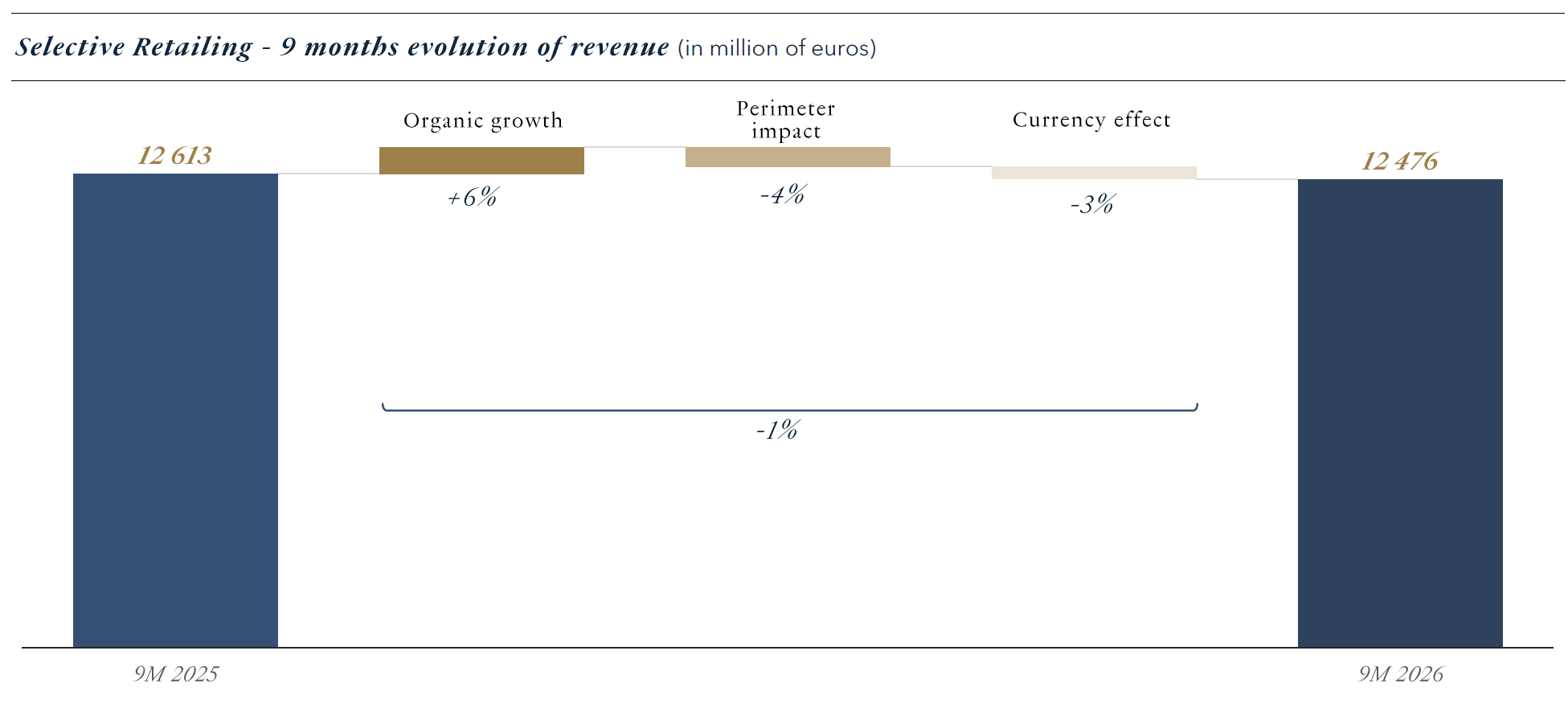
Q3 revenue €4,070m, +8% organic (+2.0% reported). 9M €12,476m, +6% organic (-1.1% reported, with a -4% perimeter effect).
Sephora grew across all regions, notably the US and Europe, with market share gains in several countries.
Drivers included:
Its historic brands,
Exclusive launches (Rhode, several C-Beauty brands) and
New market entries in Belgium and Croatia.
The company also announced a TikTok launch in the US and a partnership with Marks & Spencer in the UK.
On the call, the CFO said that like-for-like growth accounts for roughly half of Sephora’s reported growth, with the remainder from space expansion.
Le Bon Marché continued to grow, supported by cultural events and a new loyalty programme.
DFS continued to divest assets — most recently DFS Abu Dhabi travel retail to the Falic Group — producing a -7% perimeter effect on the division in Q3.
IV. CFO prepared remarks
LVMH’s quarterly calls are led by the CFO rather than by Chairman and CEO Bernard Arnault. The prepared remarks by Cécile Cabanis can be summarized in five points:
Resilience over nine months, with positive organic growth again in Q3 and currency turning positive for the first time in six quarters.
China: the quarter was marked by a more macro-led and challenging backdrop among Chinese consumers. The feel-good factor deteriorated at the very start of the quarter, causing a mid-single-digit decline in Asia, with the most tangible impact in F&LG.
Rest of the world: Europe accelerated markedly with improving trends across divisions; the US (+5%) and Japan (+6%) were slightly above their year-to-date averages, the US more consistent and Japan more uneven due to comparison bases.
Self-help as the priority: Louis Vuitton gaining traction on recent products across its price pyramid; Dior outperforming across geographies; Celine building momentum in the US; continued strength at Loro Piana and Rimowa. The Middle East situation remains a headwind.
Capital return: share buybacks of €2.3bn over the first nine months of 2026.
The outlook statement in the press release was unchanged in substance: despite an uncertain environment, the group remains confident and will focus on brand desirability, product authenticity and quality, retail excellence and organizational agility.
V. Call themes (Q&A)
1. Size and shape of the China slowdown
Several analysts (BNP Paribas, Citi, Kepler Cheuvreux, Barclays) asked about China.
