Disclaimer. Please read full disclaimer at the end of the page before reading the report. This publication is only for information and entertainment purposes. It doesn’t constitute financial advice.
The information provided in this blog is for informational purposes only and should not be considered as financial, investment, or professional advice. The valuations and analyses presented here are based on publicly available

Dear readers,
Today I present the second part of my analysis of LVMH’s Fashion & Leather Goods division. This took considerable time, as I conducted a thorough analysis of all their competitors.
I’m introducing a new format using more bullet points with more direct messages. I hope you enjoy it. Please leave your feedback at the end.
Part I: The Fashion & Leather Goods Industry
The luxury sector is highly competitive, with several dozen brands competing against each other.
Yet, despite this competition, the sector remains highly profitable.
Several factors contribute to this profitable environment:
Pricing Power: Compared to the mass market, prices increase annually to maintain status and desirability.
Limited Threat from New Entrants: The majority of brands are decades old, and the two largest are century-old brands.
Resilient Consumer Base: Customers acquiring luxury goods tend to be financially more resilient than mass-market consumers.
Exclusivity: These brands are rarely found in wholesale channels or offering discounted products.
These companies earn extraordinary margins, yet only a few new players can enter the market, and with limited impact.
There exists a massive moat in the form of branding, heritage, and quality that no other brands can replicate.
While many customers belong to the top 1%, many do not.
The fact that these expensive items are associated with society’s elite—unfortunately, we tend to associate a Rolex with a successful life—is the core element surrounding these brands.
💬A middle-class worker will purchase a €2,000 Louis Vuitton bag rather than a €2,000 bag from a new brand attempting to compete against LV. The reason is simple: LV symbols elevate the person; the alternative might not.
For some, it’s aspiration; for others, it’s belonging to a selected club in society. These items generate emotions while wearing them. In a quote from Forbes, we can see what people are willing to sacrifice to buy an LV bag:
“During the worst of the downturn last year, he adds [an HSBC analyst], “some American women decided they would spend less on food or travel and buy a Louis Vuitton handbag.””
Many middle-class people perceive these articles as stores of value. This is partially true, as the depreciation of these articles is far less severe than that of mass-market brands.
Although purchasing requires significant effort for many people, they tend to become “recurrent” buyers. It might start with a small LV bag, then a silk scarf from Hermès, leading to additional purchases.
Industry Players and Key Figures
The industry is competitive, with many brands operating in the luxury space, but three brands stand above all others:
Hermès: The king of luxury, earning the highest margins. Its financials are exceptional.
Chanel: One of the most sophisticated brands in the fashion space.
Louis Vuitton: The most popular and largest brand.
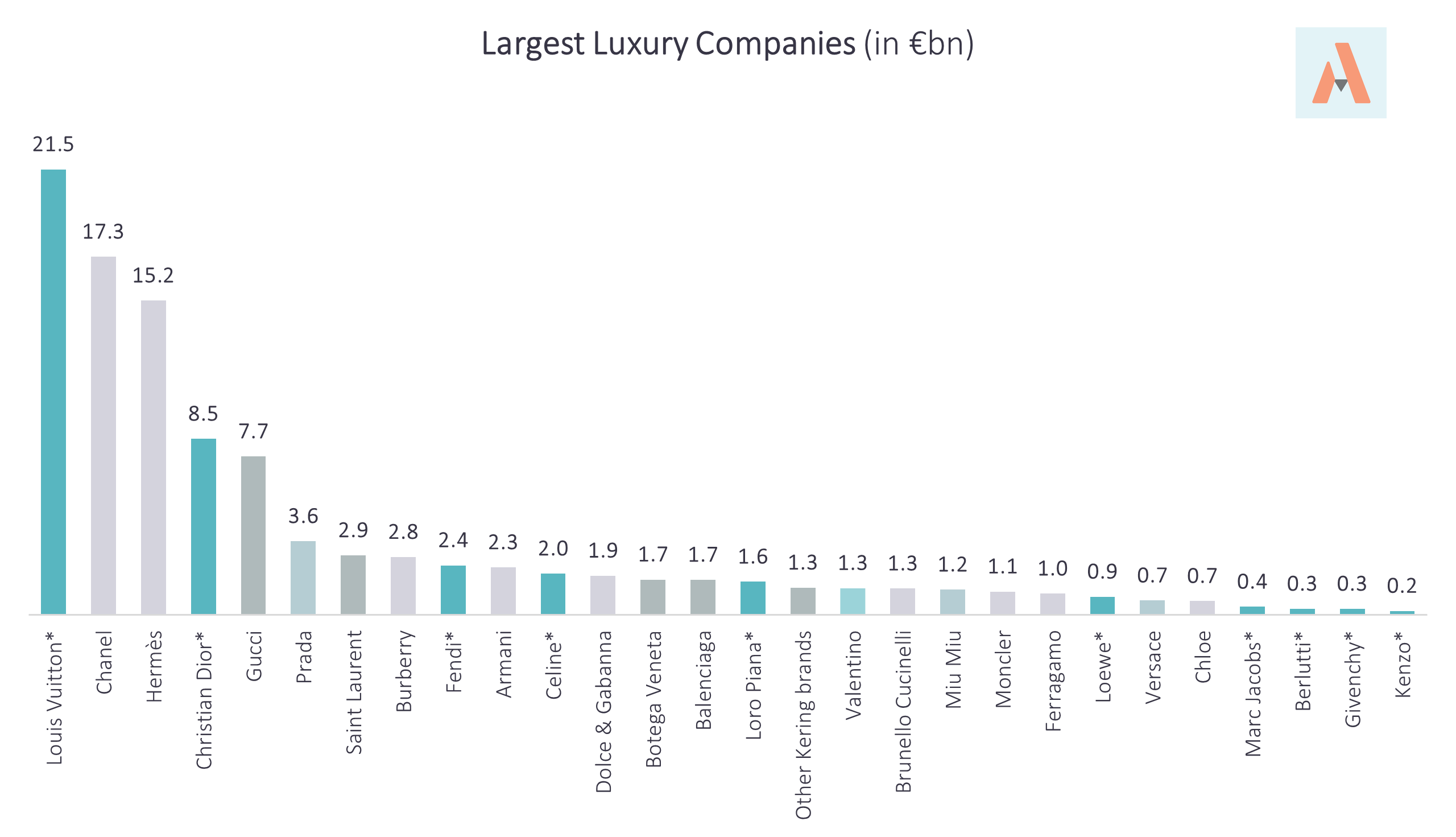
These three brands alone represent approximately €50+ billion of the total luxury industry. While the players are relatively similar in size, Louis Vuitton is the largest:
Louis Vuitton: €21.5 billion
Chanel: €17 billion
Hermès: €15 billion
📌In 2022, Bernard Arnault announced that Louis Vuitton had crossed the €20 billion mark. Assuming +7.5% growth between 2022 and 2024 (in line with segment performance), Louis Vuitton revenues would be approximately €21.5 billion.
Analyzing the largest companies, LVMH has two in the top five: LV and CD. LVMH’s market share is substantial.