
A Quarter all about AI and LLMs
Yes, Rollins, a pest control company, is heavily affected by AI
Disclaimer. Please read full disclaimer at the end of the page before reading the article. This publication is only for information and entertainment purposes. It doesn’t constitute financial advice.
The information provided in this blog is for informational purposes only and should not be considered as financial, investment, or professional advice. The valuations and analyses presented here are based on publicly available information.
Please remember that nothing in this post is investment recommendation.
I. Introduction
Rollins reported third-quarter 2026 results on October 21st. This was the quarter that had to show whether the second quarter’s residential demand “air pocket” was a blip or a trend — and the answer was uncomfortable.
CEO Jerry Gahlhoff was unusually blunt: “We are disappointed with our third quarter performance.”
AI is reshaping the way we search for solutions such as pest control in our towns, and Rollins is affected by this. Interestingly, local players are benefitting from AI without having even considered it some years ago.
Revenue of $1,089.7 million grew 6.2% but came in below the roughly $1.11 billion consensus, organic growth slowed to 4.4% (from 5.7% in Q2), and adjusted EPS of $0.34 declined 2.9% year-over-year, matching consensus only because expectations had already been cut repeatedly into the print.
Full-year organic growth guidance was revised down again, to 4–6%, from the “at least 6%” framing set in July — which itself was a cut from the original 7–8%.
It marked the company’s 100th consecutive quarter of revenue growth. That’s 25 years of constant revenue growth, even under financial crisis, pandemics, etc. Investors are somehow forgetting this about Rollins. Name any other company able to deliver this.
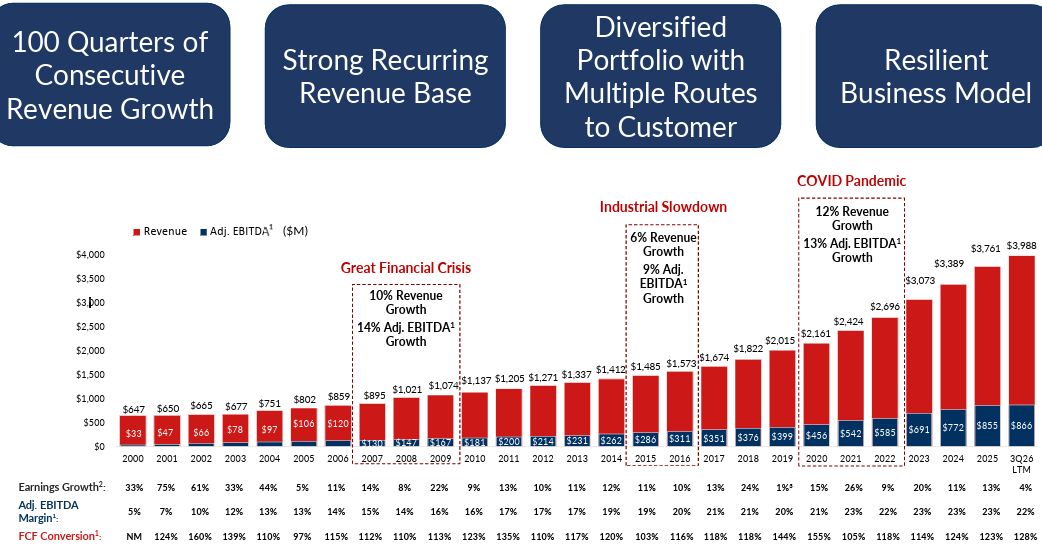
Operating cash flow jumped 26% and free cash flow conversion reached 149% in the quarter (helped by a $63 million tax refund timing benefit), funding a sharply increased buyback and a 10% dividend raise.
So, it’s a mix of everything. Company keeps growing and generating strong cash, but this year growth is decelerating.
The market reaction was positive and the stock rose about 5% on the day — to around $35, against a prior close of $33.45 — after falling roughly 23% since the July report and ~38% year-to-date. With sell-side targets cut aggressively in the days before the print (BofA at $28, Citi at $32), an in-line EPS, a bigger buyback and a dividend raise were enough for a relief rally. The stock remains far below its 52-week high of $66 and below our purchase price of $39.
