


Disclaimer. Please read the full disclaimer at the end of the page before reading the article. This publication is only for information and entertainment purposes. It does not constitute financial advice.
Please remember that nothing in this post is an investment recommendation.
Index:
I. Introduction
II. At a glance
III. Financial details
IV. Campus and leasing performance
V. Construction, development and new ground leases
VI. Guidance
VII. Earnings call: prepared remarks
VIII. Earnings call: Q&A
IX. Balance sheet, liquidity and capital
X. Recent news and market reaction
XI. Industry and competitive context
XII. What to watch
I. Introduction
Sky Harbour Group reported third-quarter 2026 results on November 10th, followed by an investor webcast at 5:00 p.m. ET hosted by CFO Francisco Gonzalez, CEO and Chair Tal Keinan and Chief Accounting Officer Michael Schmitt.
For readers new to the name: Sky Harbour develops, leases and operates Home Base Operator (HBO) hangar campuses for business aircraft at U.S. airports. Unlike a traditional FBO, which serves mostly transient traffic and earns most of its money on fuel, Sky Harbour builds private hangars (with attached offices and lounges) for aircraft that are based at the airport, and leases them on multi-year terms. The company is vertically integrated: it manufactures its own steel through its subsidiary Stratus Building Systems, acts as its own general contractor and builds a standardised hangar prototype across sites.
The quarter can be summarised in three points:
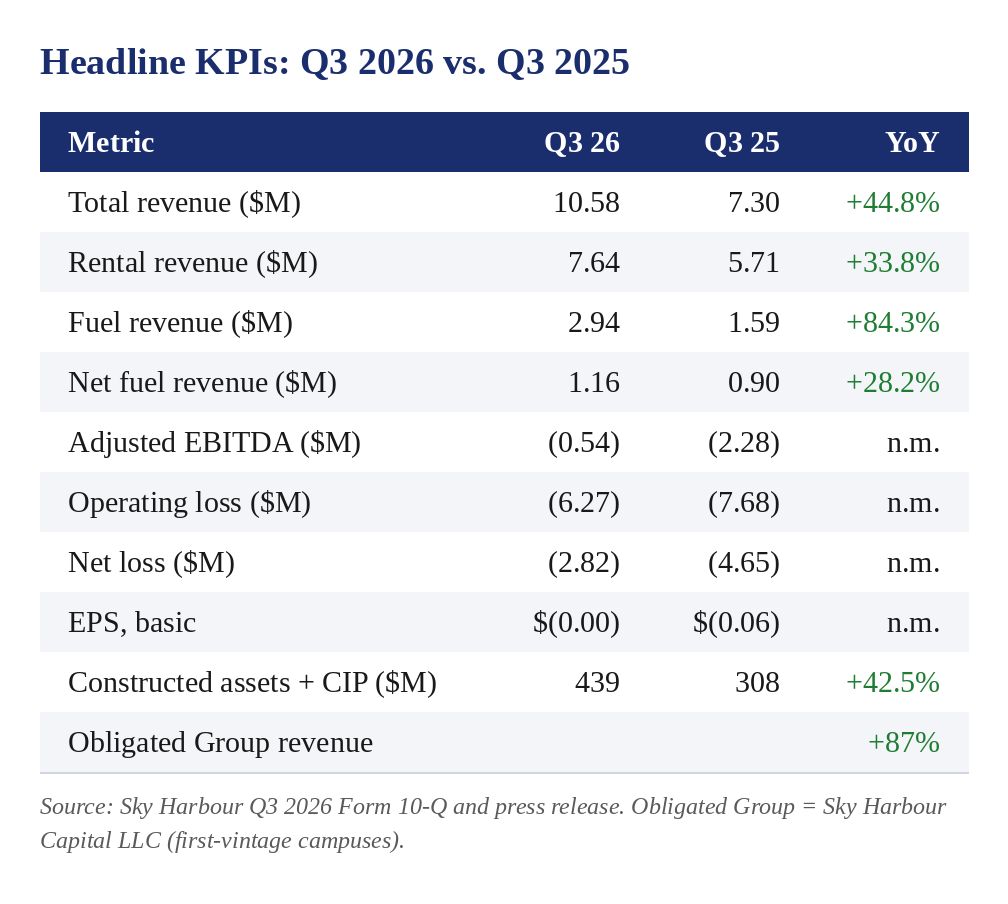
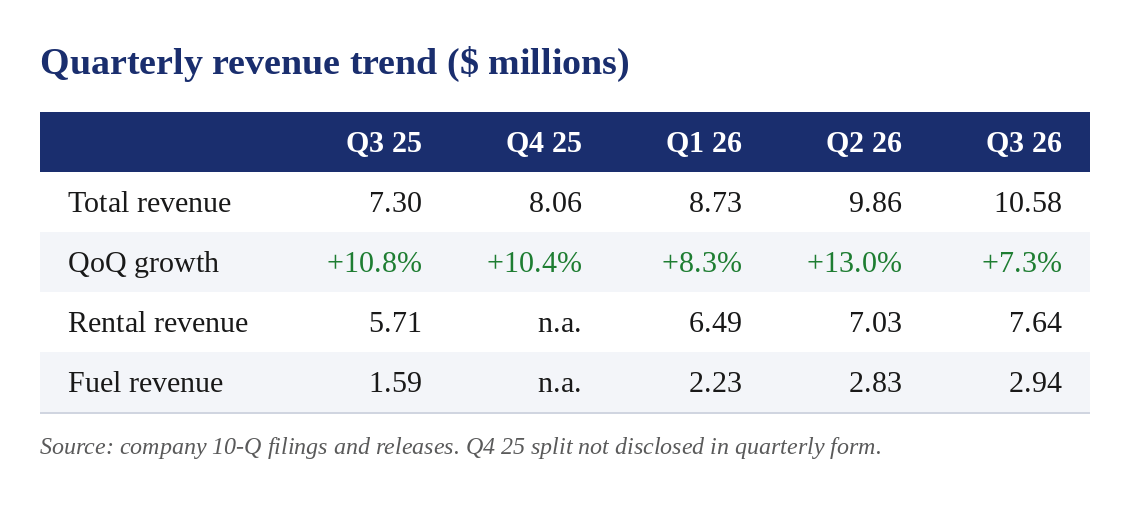
Record revenue of $10.6 million, +45% year-over-year and +7% sequentially, slightly above the ~$10.5 million consensus, driven by new campus openings and higher occupancy and rents.
Adjusted EBITDA improved to approximately −$0.5 million (from −$2.3 million a year ago), but the year-end EBITDA run-rate guidance was cut to breakeven–$4 million (from $4–6 million), while revenue run-rate guidance was raised to $44–48 million (from $42–46 million).
Pipeline progress at tier-1 airports: Los Angeles City Council approval of two ground leases at Van Nuys (~300,000 rentable sq ft), a third ground-lease option at Washington Dulles, and a new third-party hangar construction business with ~$38 million of initial contracts.
This post walks through the reported figures, the prepared remarks and Q&A, the balance sheet and the industry backdrop.
II. At a glance
III. Financial details
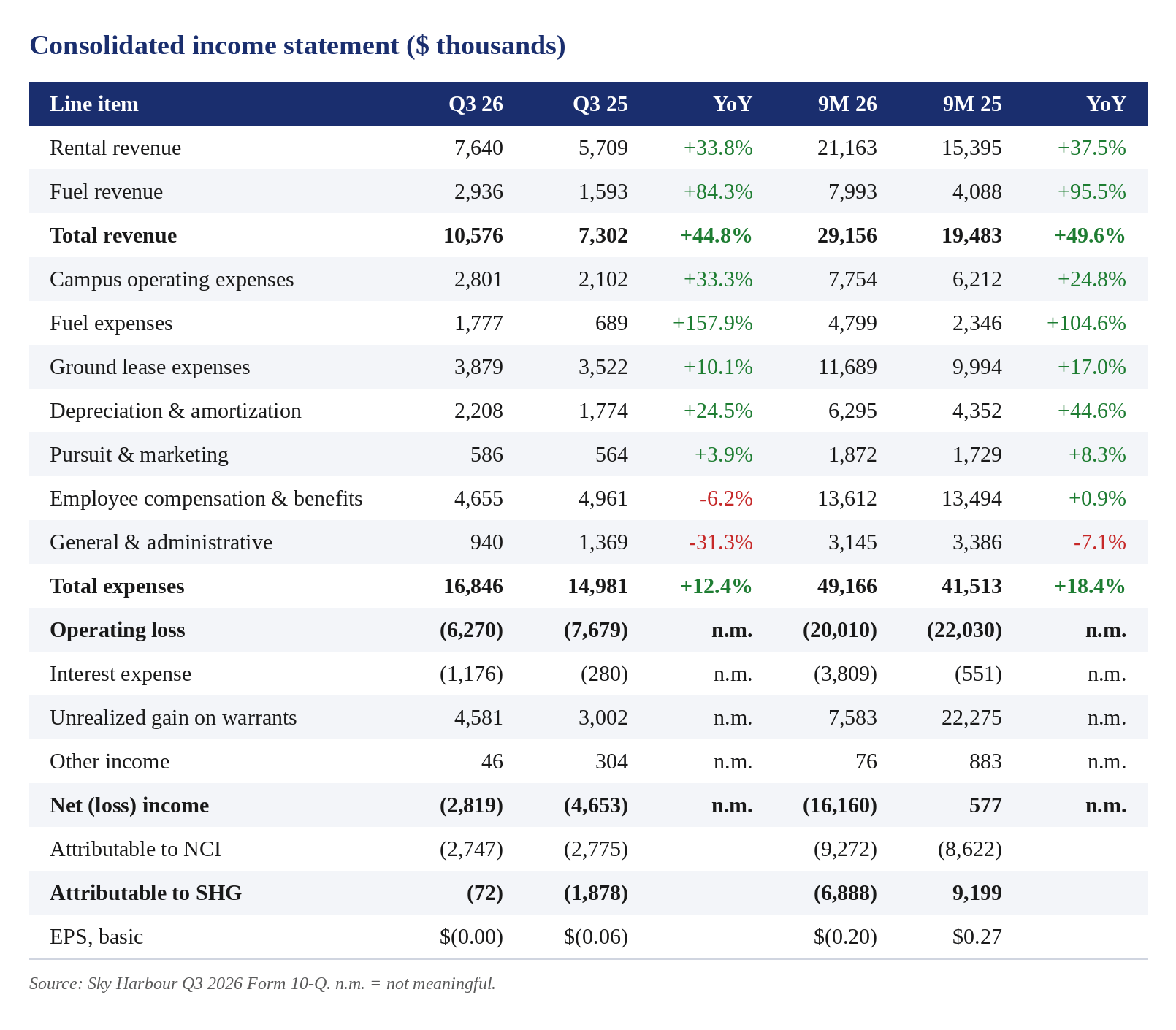
Consolidated income statement ($ thousands)
Revenue.
Rental revenue grew 34% on the opening of Miami–Opa Locka (OPF) Phase II in Q2 2026, a full year of operations at Dallas Addison (ADS, opened Q2 2025) and Denver Centennial (APA, opened Q3 2025), and rising occupancy and rents at the earlier campuses.
Fuel revenue grew faster (+84%) mainly because fuel at the CMA, ADS and APA campuses is recognised on a gross basis; the economically relevant figure, net fuel revenue, rose 28% YoY and 21% QoQ. Management said on the call that the sequential increase in net fuel was almost entirely volume, with margins broadly stable.
Expenses.
Total expenses grew 12%, well below revenue growth.
Campus operating expenses rose $0.7M on OPF Phase II staffing plus higher property taxes and insurance;
Ground lease expense rose $0.4M on leases signed at Long Beach (LGB) and Fort Worth (FTW) in Q4 2025, which accrue before those campuses generate revenue;
D&A rose with the new campuses.
Employee compensation fell 6% because the prior-year quarter included accelerated RSU vesting, and
G&A fell 31% on lower legal and accounting costs (non-recurring transaction costs a year ago and internalised functions).
Below the operating line:
Interest expense increased to $1.2M from $0.3M following the February 2026 issuance of $150M Series 2026 bonds, the Yorkville notes and JPMorgan facility draws.
Total interest incurred in the quarter was $6.3M, of which $5.1M was capitalised into construction.
The $4.6M warrant gain reflects the decline in the fair value of the warrant liability (from $0.65 to $0.17 per warrant year-to-date) and explains most of the gap between the operating loss and the net loss. Excluding the warrant gain, the net loss would have been approximately $7.4M.
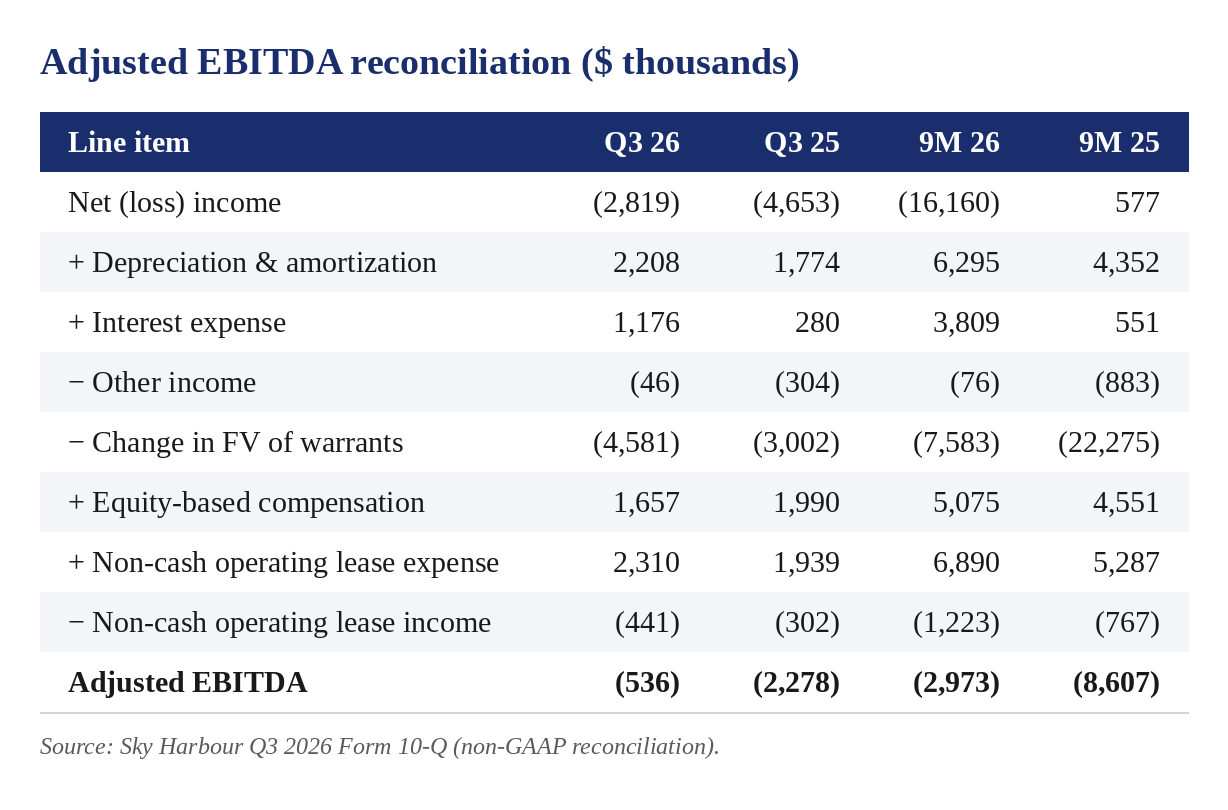
Adjusted EBITDA reconciliation ($ thousands)
A meaningful part of the adjustments is the non-cash portion of ground lease expense ($2.3M in Q3). Sky Harbour signs long-dated ground leases and recognises straight-line rent from signing, often years before a campus opens; the cash rent paid is lower in the early years. Management therefore presents adjusted EBITDA as the closest proxy for the operating economics of the portfolio.
Quarterly revenue trend ($ millions)
IV. Campus and leasing performance
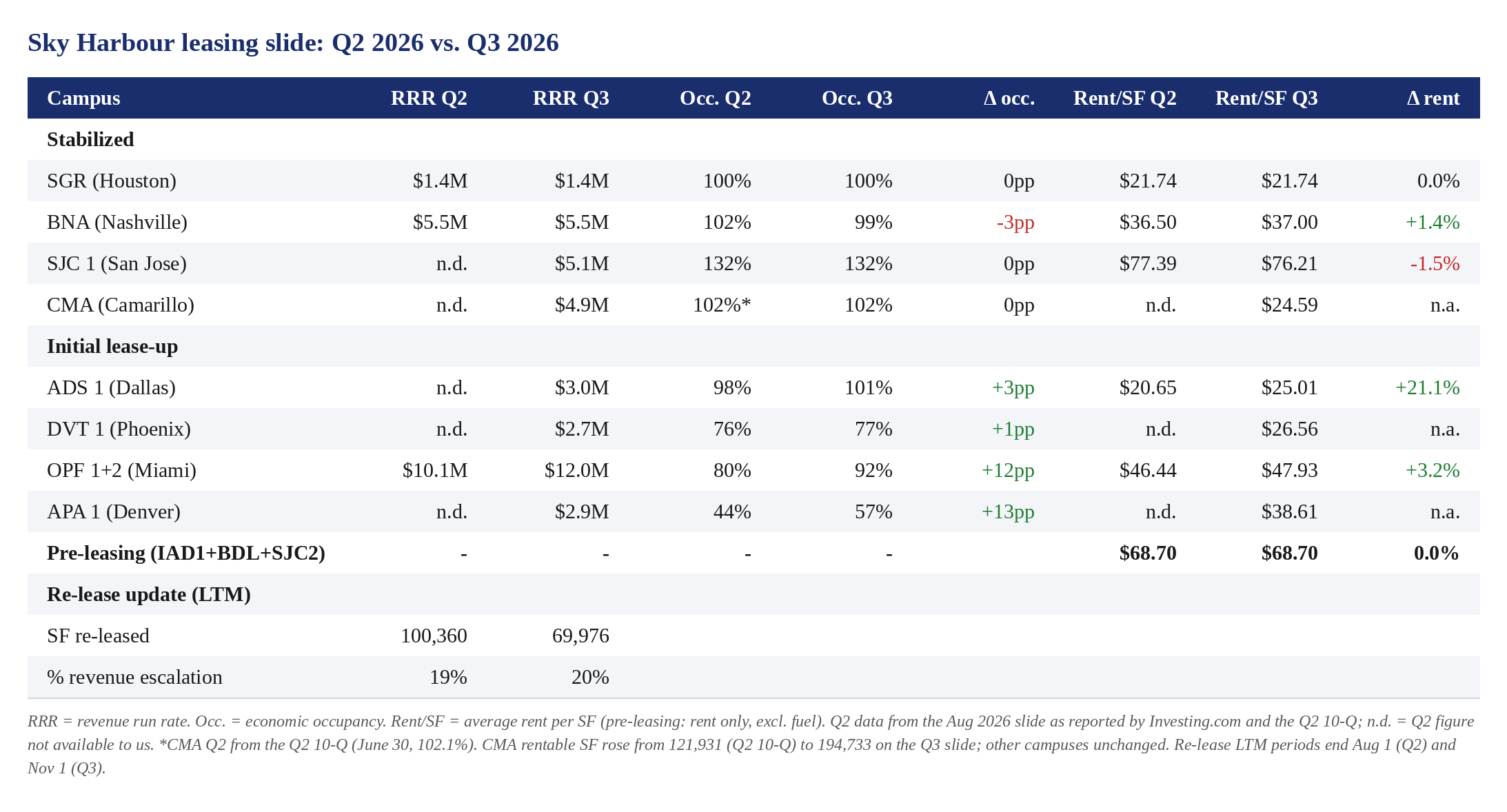
Sky Harbour does not report segments in the conventional sense. The most useful split is between stabilized campuses, which are full and re-pricing leases as they roll, and campuses in initial lease-up, which are filling space and typically accept shorter terms and lower rents to do so. A second split is between the Obligated Group (Sky Harbour Capital LLC, the bond-financed first vintage of campuses) and the consolidated group, which also carries corporate costs and the Portfolio 2 development pipeline, which for simplicity purposes, I’m not covering.
Stabilized campuses
Re-leasing spreads: average revenue escalation of 20% upon re-lease over the trailing 12 months to November 1st, before the contractual annual CPI escalators (which carry a 4% floor).
Miami–Opa Locka (OPF): combined occupancy across Phases I and II now 92%, with all 2026 leases signed at tier-1 rates. Management noted that Phase II roughly doubled campus revenue with about one additional full-time employee.
San Jose (SJC): Phase 1 at 132% economic occupancy; Phase 2, not yet built, is 100% pre-leased.
Dallas Addison (ADS) Phase 1: 101% economic occupancy.
Campuses in lease-up
Phoenix Deer Valley (DVT) Phase 1: 77% economic occupancy. No changes sin the last quarter. Has barely moved during the year.
Denver Centennial (APA) Phase 1: 57% economic occupancy (opened Q3 2025). Is up +13 p.p. vs. the last quarter.
Management framed lease-up timing as market-dependent: Miami Phase 1 took about 14 months to fill and Nashville about 18. Phase 2 expansions in markets where the company already operates are expected to lease faster than Phase 1s in new markets.
What has changed since last quarter?
Once campuses are stabilized, we will see little changes over time (revenue to grow at least at 4% per year, and expecting max occupancy in most of the airports). In the mid term, revenue should he above the 4% floor that is embeded in each lease, as this is a sort of “Manhatan” real estate - demand is above supply, and rents will keep growing at a solid pace. There will always be someone willing to pay more than current tenants to have their airplane in a Sky Harbour hangar.
Re-leases keep at a solid pace of 20% increase demonstrating the scarcity of the assets, in connection with what we discussed above.
Occupancy remains strong across all campuses, except for DVT, which at this stage remains clearly as an outlier, but let’s give some extra time to confirm.
Operations
Approximately 1.04 million sq ft of hangar, office and support space in operation, plus ~2 million sq ft of ramp and parking.
Network-wide fuel supply RFP completed, expected to improve fuel margins; multi-year equipment RFP completed, reducing future purchase costs of key motorized ground support equipment by more than 10%.
Campus-level opex efficiency program live at pilot campuses; revamped training program for line crew and general managers.
Long-run target, per the CEO: ~80% operating margins at mature campuses, with the first Obligated Group campuses described as at or near that level.
V. Construction, development and new ground leases
Company will deliver 5 campuses in the next 12 months, of which 2 will define the investment thesis of the company (Bradley and Hudson Valley).
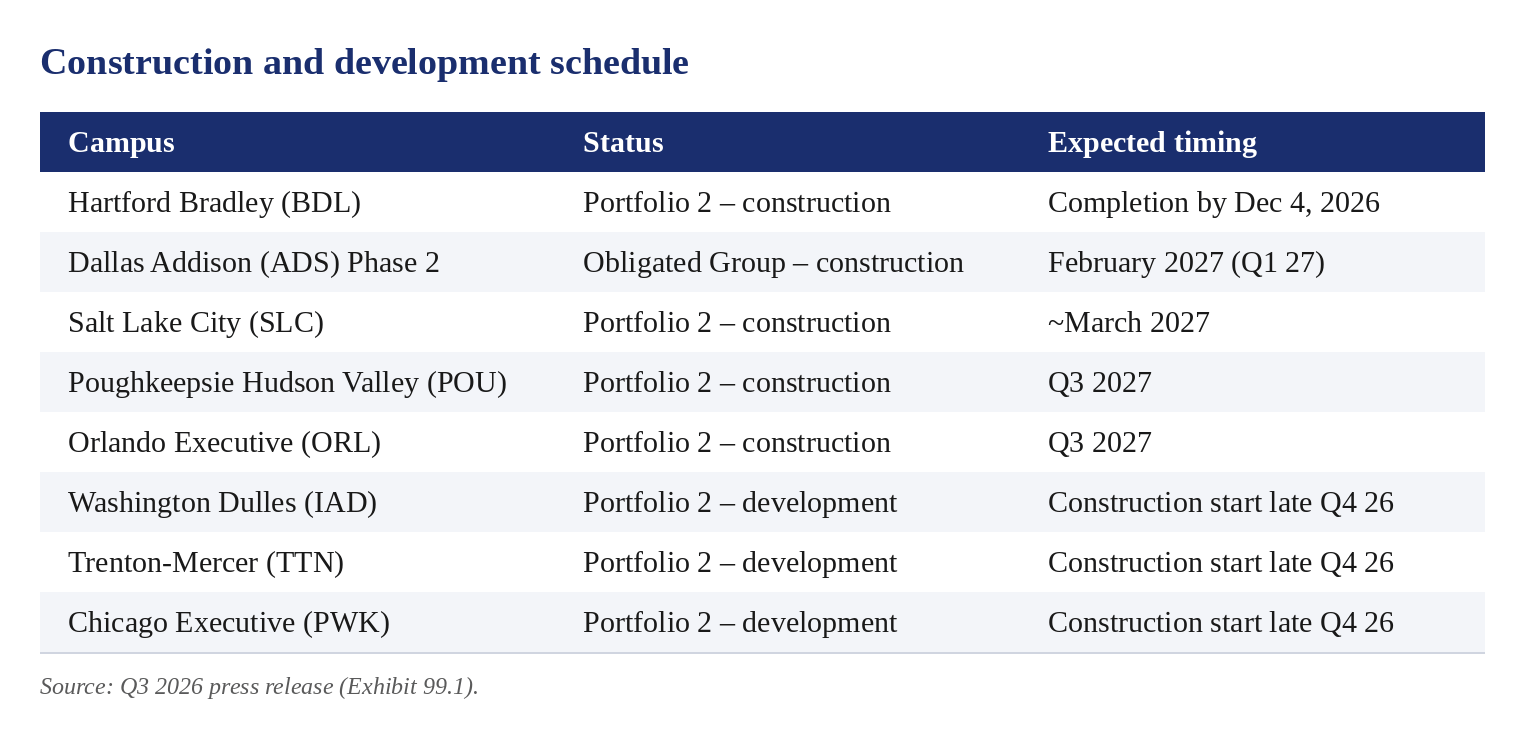
Constructed assets and construction in progress reached $439M, up $46M in the quarter and $111M year-to-date.
BDL and SLC are financed through the JPMorgan facility and the Series 2026 bonds.
BDL is expected to move from completed construction to a resident-ready campus in under 30 days, and management described it as the key operational test of the year because it is the first campus in a market where the company has no existing presence.
BDL is the key element of our investment thesis. If it turns right that demand in surrounding airports of the NYC area is high and willing to pay high rents in the $100s psf, the investment thesis will materialize. We just need to wait one more quarter to figure it out.
New ground leases
Another quarter bringing excelent news in the development side:
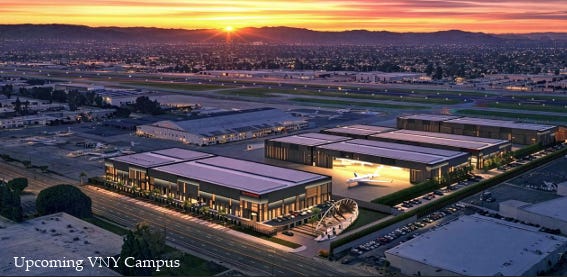
Van Nuys (VNY), Los Angeles: on November 9th the Los Angeles City Council approved two ground leases totalling over 25 acres, for an expected ~300,000 rentable sq ft of hangar, office, lounge and storage space. Formal execution is expected in the coming weeks. Keinan said the site took about six years of work and referred to it internally as “Teterboro West”, a reference to the main business-aviation airport serving New York. Worst thing is that it will take 6 years, but it’s a key addition to the portfolio. Congratulations to the management for this achievement.
Washington Dulles (IAD): on September 18th the Metropolitan Washington Airports Authority approved an option for a third ground lease, adding 15 acres and 171,520 rentable sq ft.
Third-party construction: a new business line
Subsidiaries Stratus Building Systems and Ascend Aviation Services signed turnkey development and construction contracts with a major FBO for two hangar campuses totalling 128,640 sq ft, with total contract value expected to exceed $38M (manufacturing plus construction). Management positioned this as a way to use spare capacity at the Stratus steel plant, lowering unit costs for Sky Harbour’s own campuses, and declined to give margin figures until the first projects are further along (it expects to report once they are ~50–60% complete).
VI. Guidance
Year-end 2026 annualized run-rate guidance
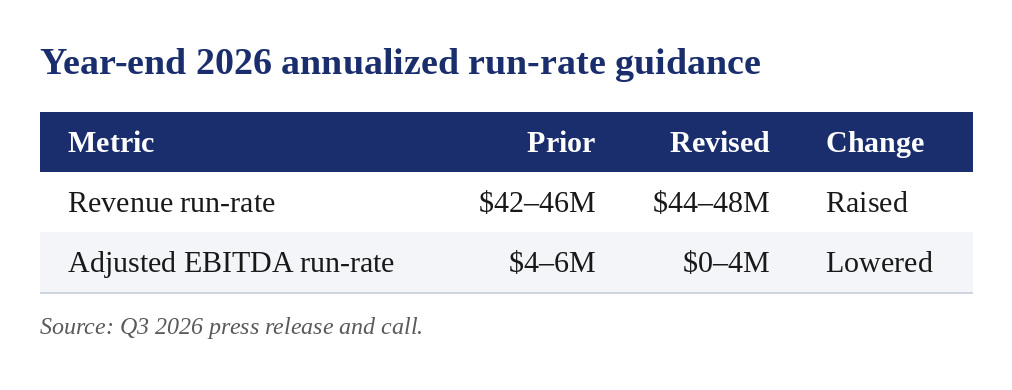
The revenue increase reflects higher-than-expected rents at OPF Phase II and higher occupancy and fueling at existing campuses, particularly San Jose.
The EBITDA reduction is attributed to timing: operating and one-time start-up costs for the early-December BDL opening, which will initially generate limited revenue, and the slippage of ADS Phase 2 into Q1 2027.
For reference, annualizing Q3 gives revenue of ~$42.3M and adjusted EBITDA of ~−$2.1M, so the revised ranges still imply a step-up in Q4.
2027 guidance will be provided with the 10-K in early March, to allow visibility on Q4 leasing, the BDL opening and ADS Phase 2.
VII. Earnings call: prepared remarks
CFO Francisco Gonzalez
He walked through the consolidated construction figures ($439M), the 45% revenue increase, and explained that operating expenses continue to grow ahead of openings, mainly through campus headcount and ground-lease accruals on sites not yet built. Consolidated operating cash flow dipped slightly negative in Q3 (−$0.7M) because of a one-time payment of almost $1M in July covering six months of accrued interest on the Yorkville loan; excluding it, operating cash flow would have been roughly breakeven to slightly positive.
On capital structure he stressed that all debt is fixed-rate: Series 2021 bonds at 4.18%, the JPMorgan facility swapped to an effective 4.73%, and the Series 2026 subordinate bonds at 6%. The company does not plan to return to the long-term bond market for three to four years, by which point it expects to be investment grade.
CEO Tal Keinan
Site acquisition. Keinan reiterated that the focus is on tier-1 airports, defined by available revenue of $50 or more per square foot, not by yield. Tier-2 sites are still pursued where development costs are low, with Fort Worth cited as an example; both tiers target 12–15% yields on cost. He emphasised that the pipeline contains “dozens” of airports where work began six to seven years ago, that new ground leases are typically direct negotiations rather than competitive RFPs, and that the timing of further wins cannot be predicted. He described demand at Dulles as very strong.
Development and vertical integration. In-house steel production, in-house general contracting and a standard prototype are presented as the core of the cost advantage. The company partly hedges steel by holding more inventory than it needs. Keinan acknowledged inflation in steel and labor, which he characterised as cyclical, while describing the integration benefits as structural.
Leasing. He contrasted stabilized campuses, where rents reset by ~20% on rollover and operating costs grow more slowly, with lease-up campuses, where the company has less pricing power (opening 12 hangars at once in Miami, for example, gave tenants leverage). He flagged that roughly 826,000 sq ft of new space needs to be leased in 2027, which he called a big challenge, and acknowledged that the leasing team had been built too slowly.
CAO Michael Schmitt
Schmitt presented the adjusted EBITDA reconciliation and the improvement to ~−$0.5M, attributing it to better operating margins at campuses in operation and slightly lower corporate overhead. He said management expects the trajectory to continue toward positive territory as rents and occupancy rise and additional campuses open. Treasurer Tim Herr added that cash and Treasuries were ~$199.4M with ~$129.2M available under the JPMorgan facility, that the company expects the public warrants to be exercised in January 2027 (bringing in over $90M of equity, per management), and that it is working with lenders on an upsize of the facility to $300M.
VIII. Earnings call: Q&A
William Catherwood (BTIG) asked what drove the pickup in leasing in Q3 and into October–November, and whether it is sustainable. Keinan attributed it to more square footage coming online and to the typical pattern of pre-leasing accumulating in the final two months before a campus opens. He added that he had been too slow in building the leasing team: the people being hired now should have been hired six to nine months ago, and hiring continues. In a follow-up on inflation, Keinan repeated that steel and labor headwinds are cyclical, while the cost reductions from vertical integration are structural; Gonzalez added that the company is investing in new equipment and painting bays at Stratus to bring more work in-house.
Timothy D’Agostino (B. Riley) asked about the competitive landscape, particularly at Van Nuys. Keinan said the competition is mainly FBOs, with Signature and Atlantic present at most major airports, and argued that HBO campuses bring new based aircraft to an airport rather than cannibalising existing operators, whereas an additional FBO mostly splits existing traffic. He said he expects two or three other HBO-style entrants to appear within about a year, although none is visible today. Gonzalez added that the new ground leases came from direct negotiation rather than RFP processes. Asked about 2027 guidance, Gonzalez confirmed it will be issued with the 10-K in early March.
Gaurav Mehta (Alliance Global Partners) asked about the economics and customers of the third-party manufacturing and construction contracts. Keinan said the numbers will be shared later, but the company is optimistic about profitability based on its own cost data versus pre-engineered metal buildings and general contractors. On the yield difference between tier-1 and tier-2 airports, he said the company targets 12–15% in both, with tier-1 status defined by revenue per square foot available; most effort is concentrated on tier-1 sites.
Maximus Alexander-Nino (Stonegate Capital Partners, for Dave Storms) asked whether Denver and Phoenix are taking longer to lease up than expected. Keinan said the timeline differs by market, citing Miami Phase 1 (14 months) and Nashville (18 months), and that ADS Phase 2 and SJC Phase 2 will be useful tests of whether Phase 2 expansions lease faster. On fuel, Schmitt said the sequential increase in net fuel revenue was almost entirely volume, with consistent margins.
IX. Balance sheet, liquidity and capital
Balance sheet and liquidity ($ millions)
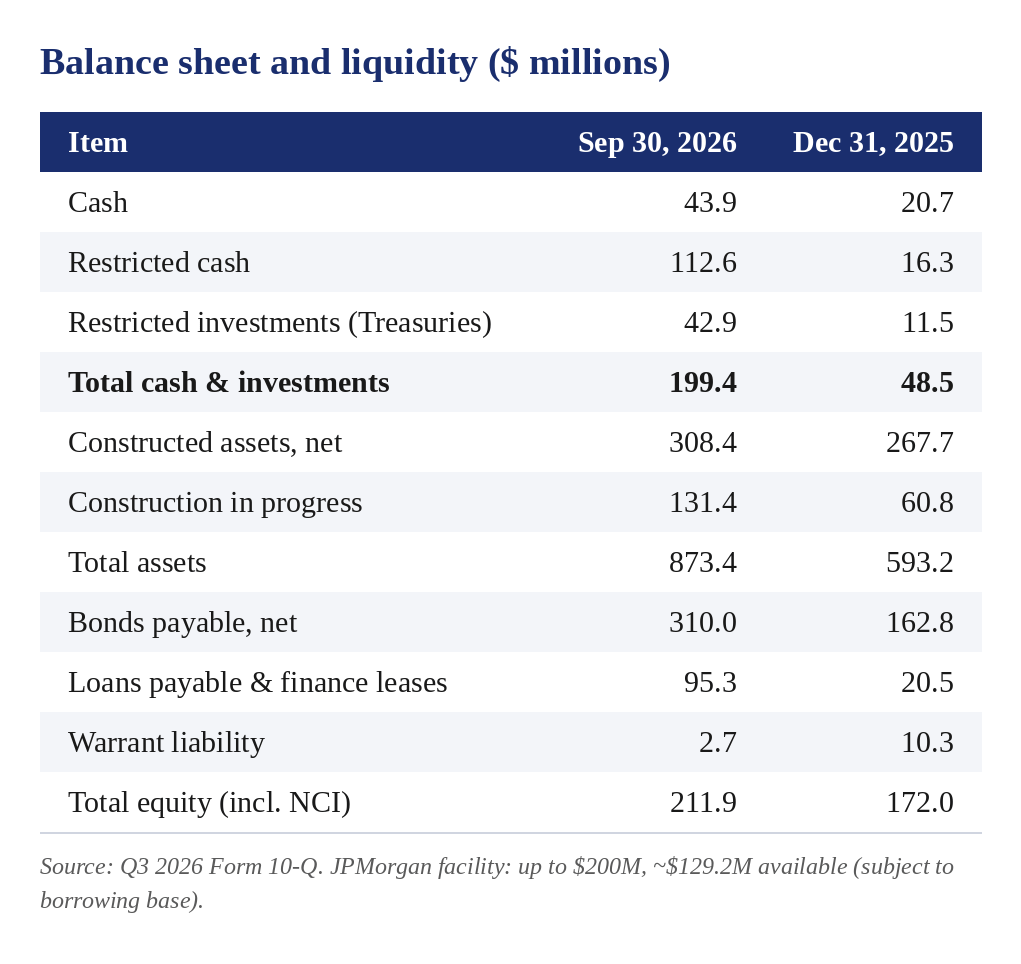
Financing activity year-to-date: $150M Series 2026 bonds (6.00%, mandatory tender January 2031), $78.8M of loan draws, $50M registered direct offering in August (5.0M Class A shares at $10.00) and $2.5M of ATM sales (none in Q3). About $95.2M remains under the $100M ATM programme.
Cash flow (9M 2026): operating cash flow −$4.1M (vs. −$6.9M); payments for construction $110.6M (vs. $58.5M).
Yorkville notes: $25M in total at 7.75%, maturing June 2027, amortising monthly since July 2026.
Share count: 39.6M Class A and 42.0M Class B shares outstanding (81.7M combined). At the November 10th close of $10.57, that is roughly $0.86B of equity value on a combined basis.
Warrants: 15.8M warrants outstanding at an $11.50 exercise price, expiring January 25, 2027, above the current share price. Management’s >$90M estimate of January exercise proceeds therefore depends on the share price at expiry.
X. Recent news and market reaction
Nov 9, 2026: Los Angeles City Council approves two Van Nuys ground leases (shares +5.9% that day).
Sep 18, 2026: MWAA approves an option for a third Dulles ground lease; the 10-Q also notes the IAD lease amendment adding the ~15-acre parcel option.
August 2026: $50M registered direct offering at $10.00 per share; Roth Capital initiated coverage with a Buy rating in July, later trimming its target to $12.50.
Analyst coverage: BTIG reiterated Buy with a $13 target on October 22nd. MarketBeat’s consensus target is ~$12.75.
XI. Industry and competitive context
Demand remains solid. Business aviation activity remains near record levels. McKinsey’s first State of Business Aviation report (October 2026) counted a record 3.9 million business jet departures worldwide in 2025, while GAMA data show business jet deliveries rising 8.2% in the first half of 2026 to 383 aircraft. Fleet growth is skewed toward larger, long-range jets, which need larger hangars than much of the legacy airport stock provides. Industry press (Aviation Week, July 2026) describes physical capacity, simply finding room to park aircraft, as the sector’s biggest constraint.
FBO incumbents are investing in hangars too. Signature Aviation expects to complete 11 hangars and six new or renovated FBOs in 2026, with a larger programme in 2027, and recently acquired the former Castle & Cooke FBO at Van Nuys, giving it three locations at the same airport where Sky Harbour has just secured two sites. Signature has explicitly cited the shift to larger jets as a reason to expand hangar capacity.
Private capital is pricing the ecosystem richly. Apollo took a co-controlling stake in Atlantic Aviation from KKR in a deal reported to value the business at nearly $10 billion, with GIC co-investing; Bain Capital, Modern Aviation and infrastructure funds have also been active acquirers of FBOs over the past two years. These transactions value fuel-and-hangar platforms at infrastructure-style multiples, a reference point for how the market might value stabilized hangar cash flows.
Sky Harbour’s positioning. The company’s argument is that the HBO model serves a different customer (based aircraft owners seeking dedicated space and minimal time to wheels-up) than FBOs, which earn primarily on fuel to transient traffic. Its new third-party contracts with a “major FBO” also suggest that incumbents may be customers as well as competitors. The CEO’s expectation of new HBO entrants within a year is a factor to monitor alongside FBO hangar build-outs. However, Sky Harbour has been very fast in securing ground qt major airports.
XII. What to watch
BDL opening (December 4th): the first campus in a the NYC area and key catalyst of the investment thesis.
2027 leasing: ~826,000 sq ft to lease, with the expanded leasing team and pre-leasing results at SJC Phase 2, IAD and BDL as early indicators.
Adjusted EBITDA crossing zero: guidance implies a positive run-rate by year-end; ADS Phase 2 in February 2027 adds revenue with limited incremental cost.
Funding: the January 2027 warrant expiry (relative to the $11.50 strike), the proposed JPMorgan upsize to $300M, and construction starts at IAD, TTN and PWK.
Third-party construction margins: first disclosure on the ~$38M FBO contracts.
Cost inflation: steel and labor trends against the 12–15% yield-on-cost target.
2027 guidance with the 10-K in early March.
Best,
Phil
This is not an investment recommendation.
The Quality Journal
Sources
Sky Harbour Group Q3 2026 Form 10-Q (SEC EDGAR, filed Nov 10, 2026)
Sky Harbour Q3 2026 press release (Form 8-K, Exhibit 99.1)
Q3 2026 earnings call transcripts (Motley Fool, Investing.com, GuruFocus)
Aviation Week (Jul 1 and Oct 14, 2026); McKinsey State of Business Aviation (Oct 2026); GAMA H1 2026 data; William Blair Aviation Services Update (Aug 2026)
MarketBeat / Stock Observer (Nov 10, 2026) for share price and analyst targets
Disclaimer:
The information provided in this blog is for informational purposes only and should not be considered as financial, investment, or professional advice. The valuations and analyses presented here are based on publicly available information and our interpretation of such data.
Please be aware that investing in stocks or securities carries inherent risks, and past performance is not indicative of future results. You should always conduct your research and consider seeking advice from qualified financial professionals before making any investment decisions.
The content on this blog does not constitute a recommendation to buy or sell any specific stocks or securities. The accuracy, completeness, or timeliness of the information provided cannot be guaranteed. We do not assume any liability for any financial decisions made based on the information presented in this blog.
Investors should carefully evaluate their financial situation, risk tolerance, and investment goals before making investment choices. Any reliance you place on the information provided in this blog is strictly at your own risk.
The opinions expressed in this blog are those of the author(s) and do not necessarily reflect the views of the website, its affiliates, or any other organization. The blog may contain forward-looking statements, and actual results may differ materially from those discussed.
We do not receive compensation for discussing specific stocks or securities.
By accessing and using this blog, you agree to abide by the terms and conditions outlined in this disclaimer. We reserve the right to modify, update, or remove any content without notice.