


Disclaimer. Please read full disclaimer at the end of the page before reading the article. This publication is only for information and entertainment purposes. It doesn’t constitute financial advice.
Please remember that nothing in this post is investment recommendation.
Index
I. Introduction and headline KPIs
II. Financial details
III. Mobility
IV. Delivery
V. Freight
VI. Uber One, advertising and the platform
VII. Autonomous vehicles
VIII. Call themes (Q&A)
IX. Capital structure, cash flow and capital allocation
X. Q4 2026 outlook
XI. Recent news
XII. Competitive and industry context
XIII. What to watch and valuation context
XIV. Conclusions
I. Introduction and headline KPIs
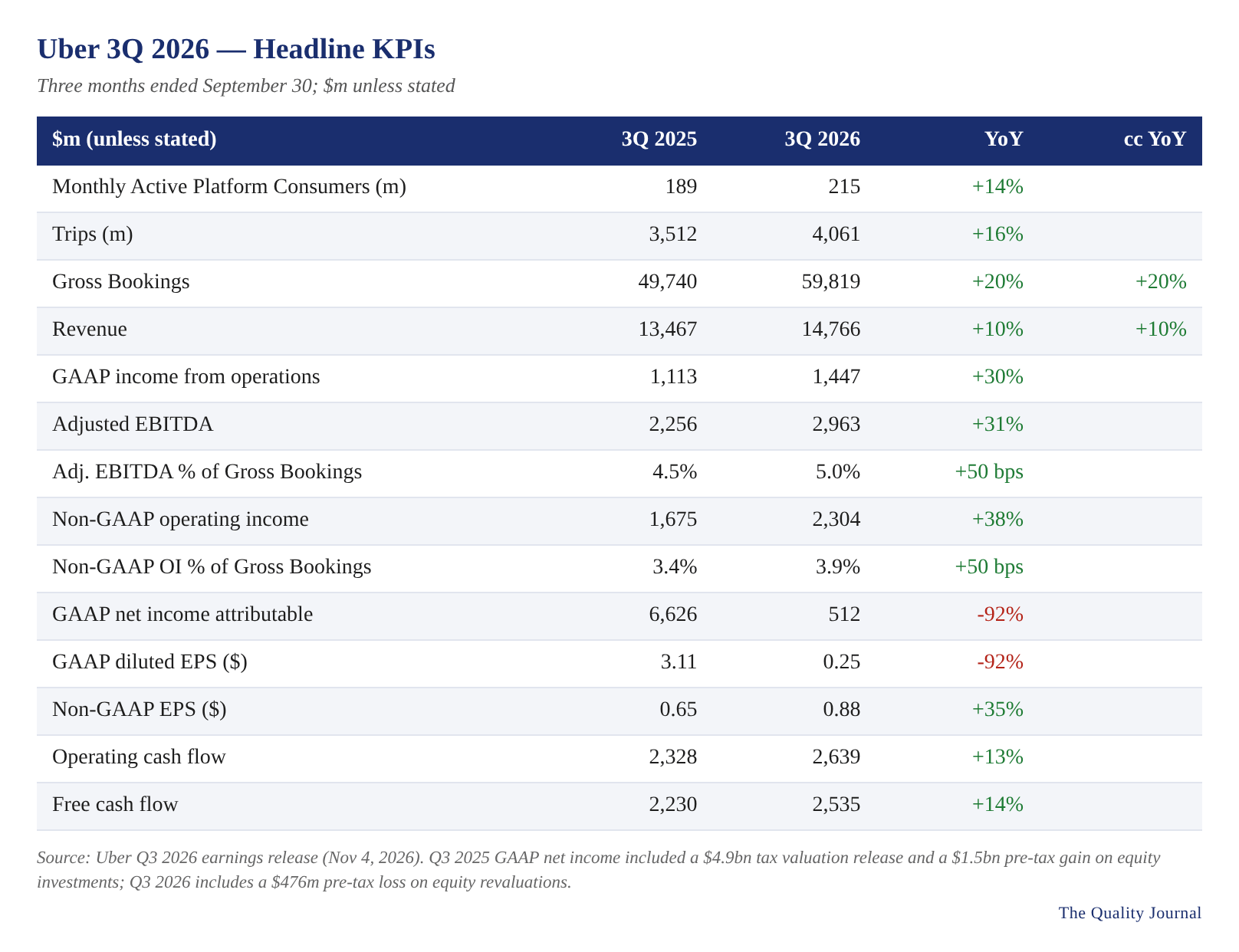
Uber reported third-quarter 2026 results on November 4th. Since our last review (1Q26), the company also reported its second quarter (August 5th) and signed three transactions that change the shape of the balance sheet: the takeover agreement for Delivery Hero (July 16th), the move to control of Careem (July 30th) and the acquisition of ezCater (October 6th).
In the release, CEO Dara Khosrowshahi framed Q3 as Uber’s fifth consecutive quarter of 20%+ Gross Bookings growth, driven by record audience and engagement. The prepared remarks were more nuanced on Mobility: overall Mobility growth ran roughly one to two points below internal expectations because elevated fuel prices and tighter driver availability constrained supply in several international markets (India, Brazil and Canada were named), with trends improving in October after targeted driver investments.
At a glance
All metrics keep growing at double digits driven by:
Company surpassing 200m customers (currently 215m monthly active customers)
Higher number of trips
Revenue grew by 10%, which is below the growth in gross bookings. This is due to:
UK business-model change (which represents ~8-1'0 p.p.). Since the start of the year, Uber is recording the driver payments in the UK as a deduction from revenue instead as a cost. At profit level. the company is unaffected. Uber estimates it’s around $1.1bn in Q3, so if we add it back, revenue will have been 18% higher (in line with growth in gross bookings).
Note that there is something really important here: Uber contributes a lot to society. Might not be the best job in the world, but in the UK alone, they are generating more than $4bn in income for the drivers. Will authorities be willing to replace physical drivers with AVs? I think that’s a question nobody is asking.Mobility underlying take rate is still a little bit lower, probably impacted by geographical and product mix, US insurance savings and driver incentives.
For the record, the Q2 quarter (reported August 5th) followed the same pattern:
Gross Bookings of $58.0bn (+22% cc), revenue of $14.2bn (+12%, with the same 8-point UK headwind),
Adjusted EBITDA of $2.82bn (+33%) and
Non-GAAP EPS of $0.81 (+35%).
GAAP EPS was $1.17, lifted by a $1.6bn net gain on equity revaluations (mainly Delivery Hero and Aurora).
Trailing free cash flow crossed $10bn for the first time.
