

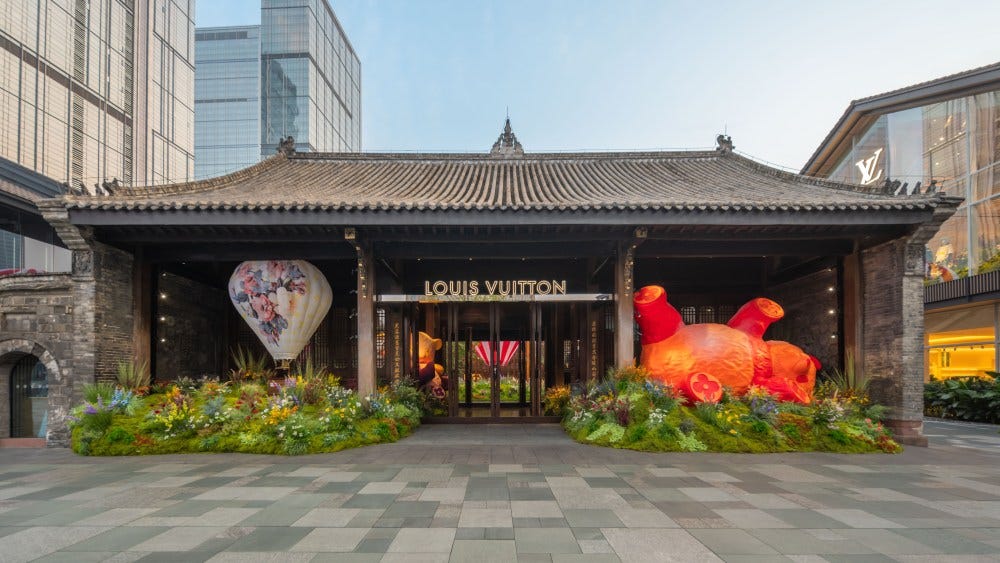

Louis Vuitton is having its worst run in China in years. You have probably seen the headline number: sales down around 30% this summer. It is a striking figure, and it needs context before anyone builds a thesis on it.
My read after going through LVMH’s Q3 numbers, the earnings call, Chinese macro data and the Molly Tea court case is simple. LV is not dealing with one problem. It is dealing with three, creating a perfect storm that is weigthing heavily in the valuation of the company and the sales in the region:
A cycle problem. Chinese consumers are saving instead of spending, and in July Beijing gave its richest citizens a new reason to keep their heads down.
A category problem. Logo-driven leather goods are the weakest corner of Chinese luxury, and LV is the most exposed brand in that corner.
A brand problem. A trademark win against a local tea chain turned into a public-relations loss at the worst possible moment.
Let’s take them one at a time.
First, what the numbers actually say
The -30% is not an LVMH number. It comes from JL Warren Capital, which tracks traffic and activity at boutiques in roughly 15 Chinese malls.
Their estimates for LV are devastating:
July about -30%
August: -20% to -25%
September about -13%
That is directional, not audited and confirmed by LVMH. But it is not noise either, because LVMH did confirmed the trend when it reported Q3 on October 12:
Group revenue of €18.5bn, +1% organic, below expectations.
Fashion & Leather Goods (where LV and Dior sit) -5% organic, against a consensus of roughly -1.8%.
Asia ex-Japan -5%.
Chinese customers’ spending worldwide down in the mid-teens; mainland China down double digits; Chinese spending abroad down mid-single digits.
Meanwhile Watches & Jewelry grew 6% and Selective Retailing (Sephora) 8%.
“On the clienteles, you have the Chinese demand, which has been negative mid-teens. Japanese have been down mid-single digit negative, and the rest of the Greater Chinese part has not changed a lot versus the previous quarter. On offshore versus onshore, for the Chinese cluster, offshore was negative mid-single digit. Onshore, a decline double digits, so a bit more than the cluster average” Cécile Cabanis (CFO, LVMH)
I think that 2 things stand out:
First, the problem is concentrated in fashion and leather, not in luxury as a whole.
Second, the monthly trajectory — a deep hole in July, gradual improvement into September
“What we can say is that the news flow has not been particularly good in China in the summer. So this has really waited on the feel-good factor and created a short-term subdued Chinese backdrop. Again, we hope it will subside. We are not sure when, and we make sure that we work on what we control, which are really self-help initiatives that are gradual, but that are already paying off.” Cécile Cabanis (CFO, LVMH)
Based on what management shared during the call, we can try to assess the different impacts. I estimate revenue decline at Louis Vuitton was at least -5%:
Logistical problem (area not disclosed): -1% of growth
China: ~ -4% of growth (assuming average decline of -20% during the quarter and a weight of Mainland China assumed at 20%)
Rest of regions: I would assume neutral impact overall
Problem one: the Chinese consumer is saving, not spending
This is not mainly a story about incomes. In the first half of 2026, disposable income per head grew 4.2% in real terms, while spending grew only 2.7%. Households are putting the extra money aside. The World Bank puts the precautionary savings rate at 32.4%, and real household consumption grew just 2.6% in Q1, the slowest pace since late 2022.
The reason is the wealth effect running in reverse. Housing is where Chinese families keep most of their wealth, and new-home prices were still falling in August: -0.9% in tier-one cities, -2.7% in tier two and -4.1% in tier three. When the main asset on your balance sheet keeps shrinking, a $3,000 handbag is the first thing you postpone.
The summer data shows a two-speed consumer:
Retail sales, YoY
July 2026: +0.6%
August 2026: +0.4%
Jewelry sales, YoY
July 2026: -10.1%
August 2026: -17.5%
Youth unemployment (16–24)
July 2026: 17.9%
August 2026: 18.9%
Cosmetics grew 4.9% in August and services held up well. Big-ticket, visible purchases are what’s getting cut. Rising youth unemployment matters more for LV than it might seem: young aspirational buyers drive entry-level products, gifting and social-media visibility.
“We’ve been seeing and having debates on what could be some more drastic immediate moves, like price cuts. We don’t believe this is something that is advisable, because whatever you do, you need to keep in mind the desirability of your brand and making sure that what you do can endure momentum for the next cycle to come. So yes, it take a bit of time, but I don’t think there are a lot of shortcuts here.” Cécile Cabanis (CFO, LVMH)
The offshore tax shock: when the rich stopped spending too
For two years the story in Chinese luxury was that the middle class was pulling back but the very rich kept buying. In July that buffer cracked.
On July 24, China’s Ministry of Finance and the State Taxation Administration published new rules on the taxation of offshore trusts — for decades a grey zone that wealthy families used to hold assets abroad, often through Hong Kong. The key points:
A 20% tax on the gain in value when shares, property or other assets are moved into an offshore trust.
Income generated by those trusts, and by the offshore entities they control, is taxed 20% every year.
A 90-day window to declare and settle unpaid tax on assets placed in trusts since January 2023 and on trust income received before 2026, without late-payment penalties. That window closes around October 22.
Broad anti-avoidance rules: people who take foreign citizenship or residency but keep their main economic interests in China can still be treated as Chinese tax residents.
This is not a niche issue. According to KPMG and Julius Baer, more than half of China’s super-rich use offshore family trusts. At the same time, tax offices in Beijing and Hangzhou have started enforcing tax on returns from offshore insurance policies.
What LVMH said on the call. Asked directly about the tax crackdown, CFO Cécile Cabanis said it had hit the “feel good” factor of Chinese consumers. She framed the quarter more broadly as a sharp, macro-led deterioration in Chinese sentiment with a tangible impact on discretionary spending. Two other comments are worth noting: she said LV needs to step up and find the right balance between innovation and heritage, and she rejected “drastic measures” such as price cuts.
Why it matters more than the tax bill. The direct cost is manageable for most of these families. The bigger effect is psychological. As one Gavekal analyst put it, most investors probably never paid tax on offshore income, and the enforcement campaign looks here to stay. If you are a wealthy client who just learned the state is looking closely at your offshore wealth, walking out of a flagship store with several logo bags is not the signal you want to send. Some of these clients also need to keep cash available for the settlement.
The timing was brutal. The rules landed in the same week the Molly Tea story went viral and Chinese stocks were falling. Industry data showed the top 25 luxury brands down more than 10% in July, with VIP clients turning visibly more cautious. LV took a hit on both flanks at once: the aspirational buyer was already gone, and now the top client was pulling back too.
Problem two: the logo bag is falling out of favor
LV’s China problem predates this summer. According to Bain, Chinese personal luxury fell 17–19% in 2024 and another 3–5% in 2025. Inside that, beauty grew 4–7% last year while leather goods fell 8–11%, hurt by years of price increases and innovation that buyers didn’t see as enough to justify them.
Underneath the numbers is a cultural shift:
From display to discretion. In a weak economy, an obvious logo can read as unsophisticated, or simply as bad taste. Quiet luxury names like Loro Piana have held up far better than logo-heavy brands. Prada Group grew 5% organically in H1, with Asia-Pacific up 6% — proof that this is not only macro.
Local brands with cultural credibility. Songmont in bags, Laopu Gold in jewelry, Mao Geping in beauty, To Summer in fragrance. They don’t need to replace LV; capturing one gift or one entry-level purchase is enough to shrink LV’s share of wallet.
Resale. China’s second-hand luxury market grew 15–20% in 2025 while new luxury shrank. If you can buy the icon cheaper pre-owned, the full-price new bag has to work much harder.
Travel without shopping. Chinese tourists are travelling more but buying less. During Golden Week departures rose 9.3%, yet spending per Chinese shopper at Lotte Duty Free fell 19% even as the number of shoppers rose 74%. Experiences are winning over shopping bags.
This is the part I worry about most as an investor, because it doesn’t reverse when sentiment does.
Problem three: winning in court, losing the room
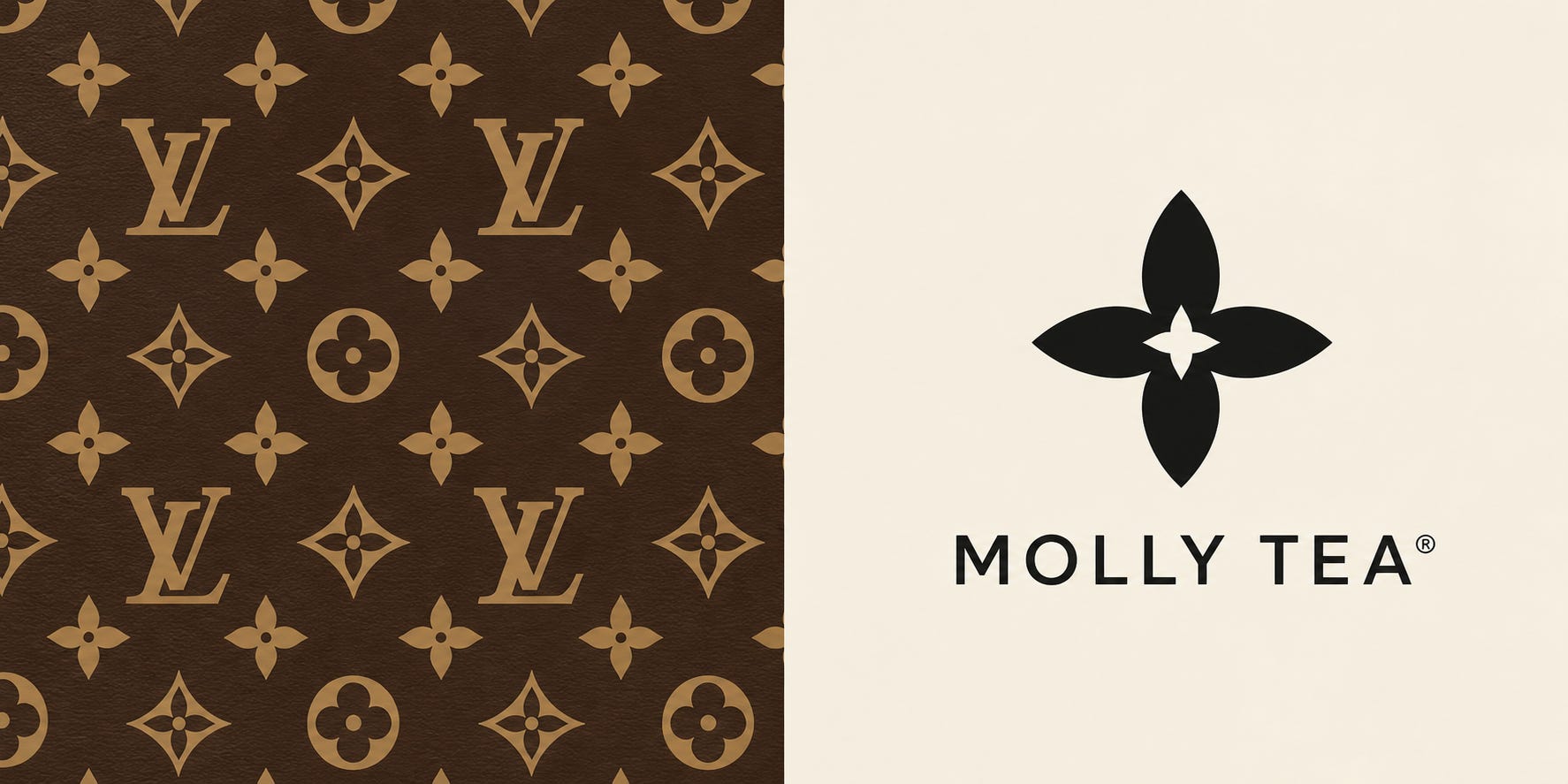
Molly Tea is a Chinese tea chain with more than 2,000 stores. In 2024 it replaced its original logo with a black, geometric four-petal flower and rolled it out across stores, cups and apps. LV sued in May 2025. On June 29, 2026, the Suzhou Intermediate Court ruled for LV: Molly Tea must stop using the logo, publish statements on its website, WeChat, Weibo, Xiaohongshu and Douyin, and pay around €1.3 million for damages. Molly Tea has appealed.
Legally, LV had a strong case. The court didn’t give LV ownership of four-petal flowers in general. It compared the specific geometry — symmetry, curves, proportions, the central space — with seven registered LV marks and found substantial similarity. Molly Tea had previously tried to register several four-petal flowers and most applications were rejected over prior marks, yet it kept using the emblem. The court also cited consumer comments assuming the two brands were collaborating, which is plausible in an era of luxury-meets-mass-market collabs.
Publicly, LV lost. The court asked whether one commercial sign was too close to another. Chinese social media asked a different question: can a French company own a flower that appears in Chinese art and architecture for centuries? The LV monogram was designed in 1896, drawing partly on Japanese influences. Critics pointed to the traditional baoxiang flower, persimmon calyxes and Tang-era motifs.
The case fit every negative frame available: David versus Goliath, reverse cultural appropriation, “who would confuse a jasmine tea with a handbag,” and rising consumer nationalism. The hashtag passed 400 million views on Weibo. Molly Tea gained about 250,000 followers in 30 days, and a slogan saying it had lost the case but won the public’s heart passed 30 million views.
LVMH acknowledged that the controversy hurt sales at the start of the quarter but said it could not quantify the effect. The lesson for LV is that a case can be legally winnable and still destroy more brand value than it protects. Defending the specific mark was right; failing to explain that it was not claiming the motif itself let others write the story.

For those new in the platform, we are offering a one-time discount for our annual subscription. We believe the value provided is far above the price and there is lot of interesting content coming in!
Final Thoughts
It’s a delicate situation in China, but it’s not the end of the world. These debates tend to be short-term ish, but right now, it’s the perfect storm.
There are still consumption issues in the region, tax pressures on wealthy people, and a controversial logo.
Looking at the trend, the worst seems over, with sales in September still at c. -15%, but regaining confidence from consumers (July and August was above -20%).
In the long-term, the logo that LVMH is protecting is what consumers will probably keep desiring to show status. Right now it can be impacted by this short-term media / social media, but with the right management, this can be turned around in the next quarters. As CFO said, it will take time, and certainly this will keep putting pressure on the shares of LVMH.
Last, there is something I want to highlight: always review what management says and how they frame it. This quarter, what the company mentioned about Louis Vuitton is the below extract from the Investor Presentation:
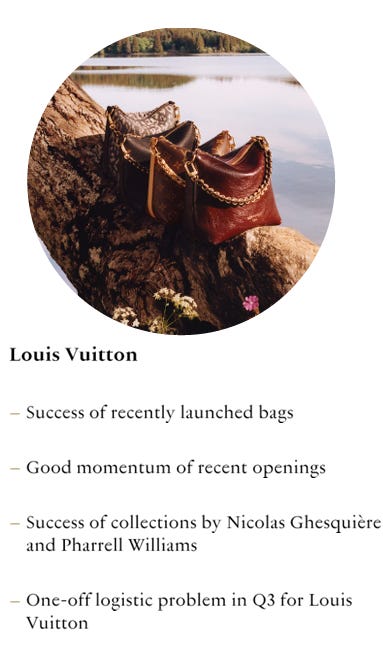
“Success”, “good”… and for issues “one-off”. The situation is bad, and these bullets are not reflecting the situation. This is not to say things against management (LVMH is very well run), but to be conscious that we need always to do our own research, and this is what we did today, confirming that the problem in China is real and big, and that it will take time to resolve.
We will keep to monitor the situation and provide updates if material. Next week we are delivering the next chapter of the LVMH series, to look into more positive things
Thank you and have a great weekend
Phil
